

Model History
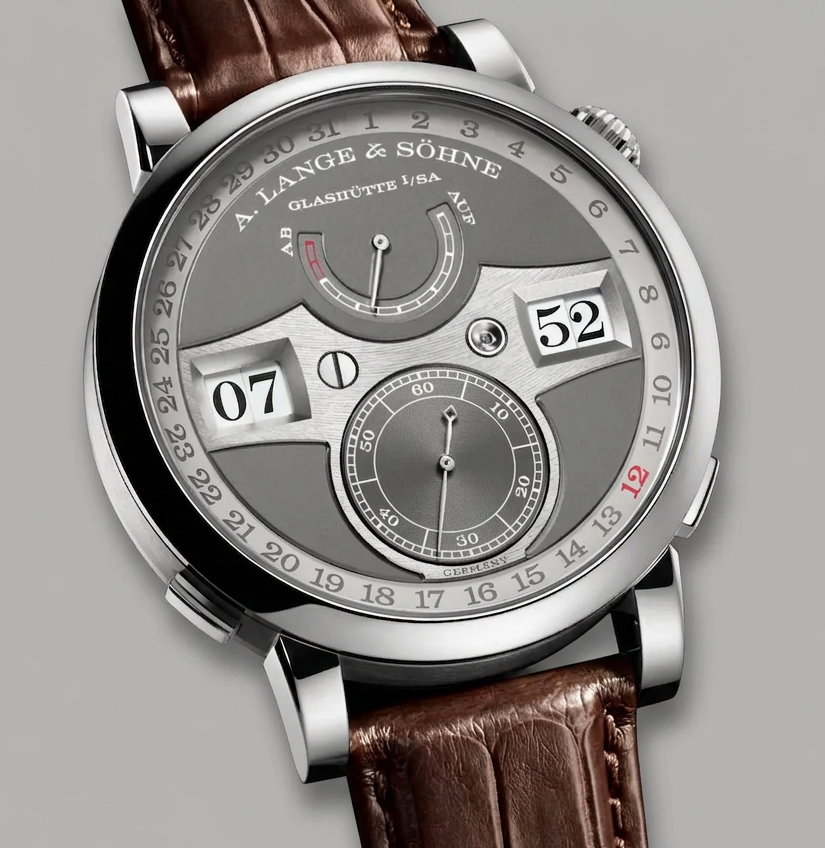
Presented in 2009, the Zeitwerk breaks with more than a century of tradition: instead of hands, it shows hours and minutes through three numeral discs that "jump" forward at the exact top of each minute, like a digital display but entirely mechanical. It's the first serially produced wristwatch to achieve this with such precision, and that same year it won the Aiguille d'Or, the top prize of the Grand Prix d'Horlogerie de Genève.
The technical challenge was considerable: making three numeral discs jump instantly requires a large burst of energy released in a fraction of a second, which would normally compromise timekeeping accuracy. A. Lange & Söhne solved it with a patented constant-force escapement, which stores energy and releases it in regular impulses independent of the mainspring's tension — a mechanism still rare today in a series-produced wristwatch. The twin barrel provides 72 hours of power reserve, enough for 72 complete cycles of the three discs.
Over the years the family has grown with a refined second-generation calibre and variants such as the Zeitwerk Date (with an added date display) and haute-horlogerie versions with a striking mechanism. It remains recognizable for the vertical "time bridge" in German silver that separates the two numeral windows, available in platinum or pink gold.
Technical Specifications
Key References Over Time
The Zeitwerk's constant-force escapement was such a significant innovation that it earned the watch the Aiguille d'Or in 2009 — the top overall prize of the Grand Prix d'Horlogerie de Genève, rarely awarded to a watch with such a "technical" character rather than a classic complication.