

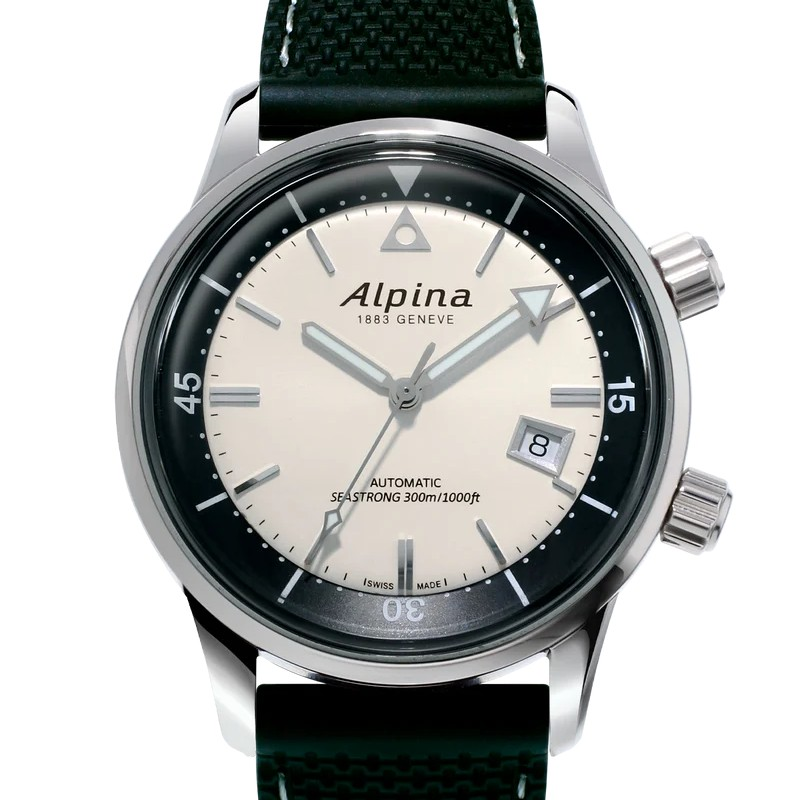
Model History
The original 1969 Alpina 10 Seastrong was a genuine professional diving instrument: water-resistant to 200 metres, automatic movement, and above all built around a dual crown — one for setting the time, the other for the rotating decompression bezel. The case used a patented "super compressor" mechanism, in which water pressure, increasing with depth, clamped the case back even more tightly against its gasket instead of threatening to force it open.
The modern reissue, "Seastrong Diver 300 Heritage" (2021), pays tribute to that original in style — dual crown, bezel design, black sunray dial with gilt indices and hands — while using a contemporary case construction rather than the true historic super compressor mechanism. It houses the automatic calibre AL-520 (Sellita SW200 base), with water resistance raised to a more modern standard of 300 metres.
Seastrong remains today the brand's most direct link to its history as a professional dive watch maker, alongside Startimer (aviation) and Alpiner (sport and mountain) among the three main collections in the current catalogue.
Technical Specifications
Key Executions Over Time
The "super compressor" mechanism of the 1969 original was ingenious precisely because it inverted the intuitive logic: instead of water pressure threatening to force its way into the case, the deeper a diver went, the more tightly the case back was clamped against its gasket, improving the seal.