

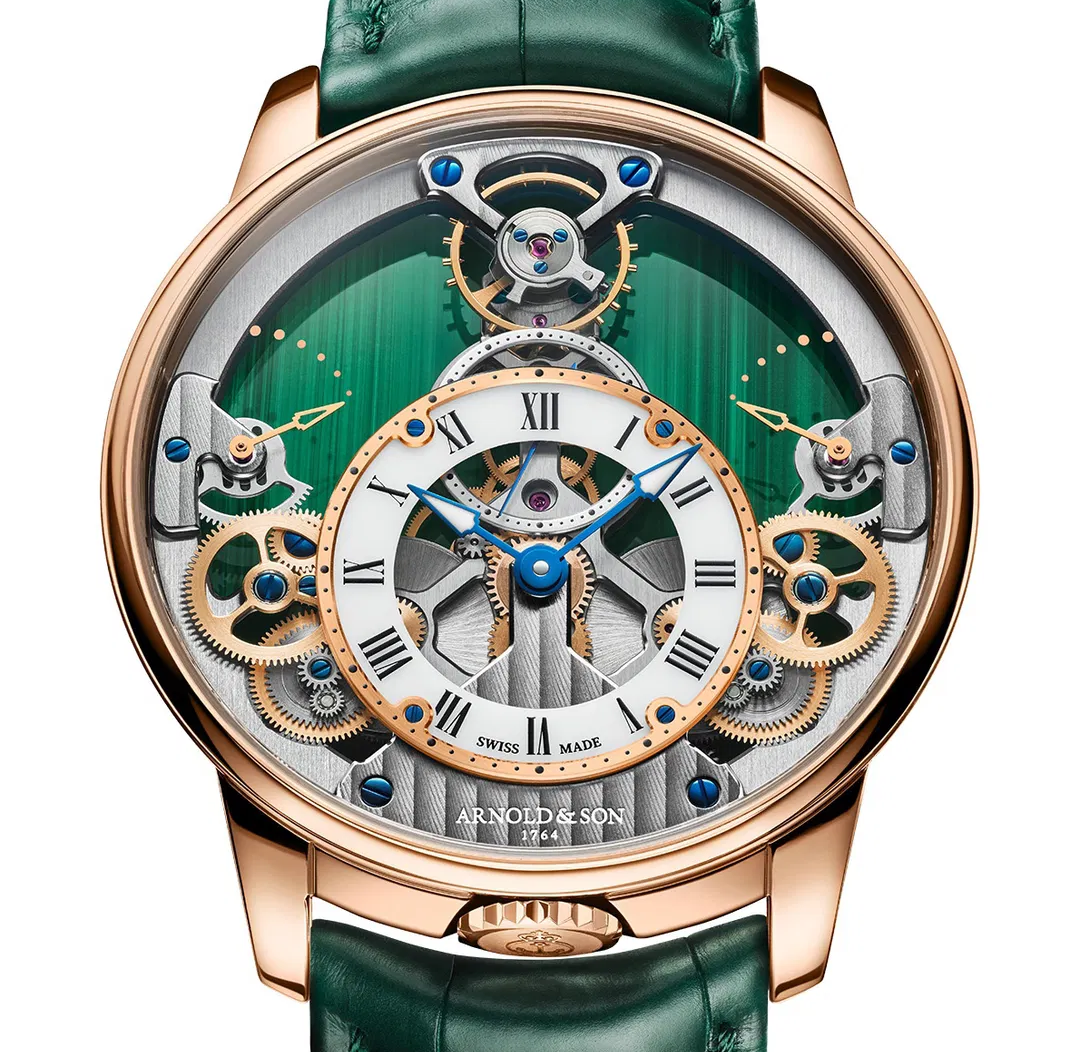
Time Pyramid
Model History
First presented in 2012, the Time Pyramid is arguably the watch that best represents the "chronometry" pillar on which Arnold & Son builds its modern identity: rather than hiding the mechanism beneath a solid dial, the manufacture arranges it frontally in a pyramid-shaped architecture, with two barrels at the base, a gear train laid out in a line at the center and the balance wheel at the top, clearly visible at 12 o'clock.
In 2023 the model was updated with a case reduced from 44.6 to 42.5 mm in diameter, adapting it for a wider range of wrist sizes without altering the technical layout: the hand-wound A&S1615 calibre retains the two barrels in series that feed a 90-hour power reserve, with two separate power-reserve indicators — one for each barrel — on the off-center opaline white dial.
The sapphire case back, embellished with a blue aventurine disc, offers a further glimpse of the mechanics from behind. The case, available in 18-carat rose gold or 950 platinum, is paired with a hand-stitched blue alligator strap, in a limited production run (88 pieces in rose gold, 38 in platinum for the 2023 version).
Technical Specifications
Main Executions
The pyramid shape isn't a stylistic flourish applied to a conventional movement: it's the very arrangement of the components — barrels at the base, gear train in the middle, balance wheel at the top — that geometrically generates the triangular profile giving the watch its name, made possible only by laying out the movement's organs in a line rather than in the usual layered stack.