

Model History
The Premier debuts in 1943 through the will of Willy Breitling, who senses that the postwar market is ready for a return to formal elegance after years dominated by purely instrumental watches. It is the manufacture's first collection not born for aeronautical or sporting use: more compact cases, between 32 and 38 mm according to the original references, available both in steel and solid gold, and an aesthetic language designed for city attire rather than the cockpit. In the same year of its launch Breitling also presents within the line the Duograph, a refined split-seconds chronograph (with an independent stop pushpiece), later followed by the Datora, fitted with a full calendar and moon phases: two complications that show the line's elegance did not give up mechanical sophistication at all.
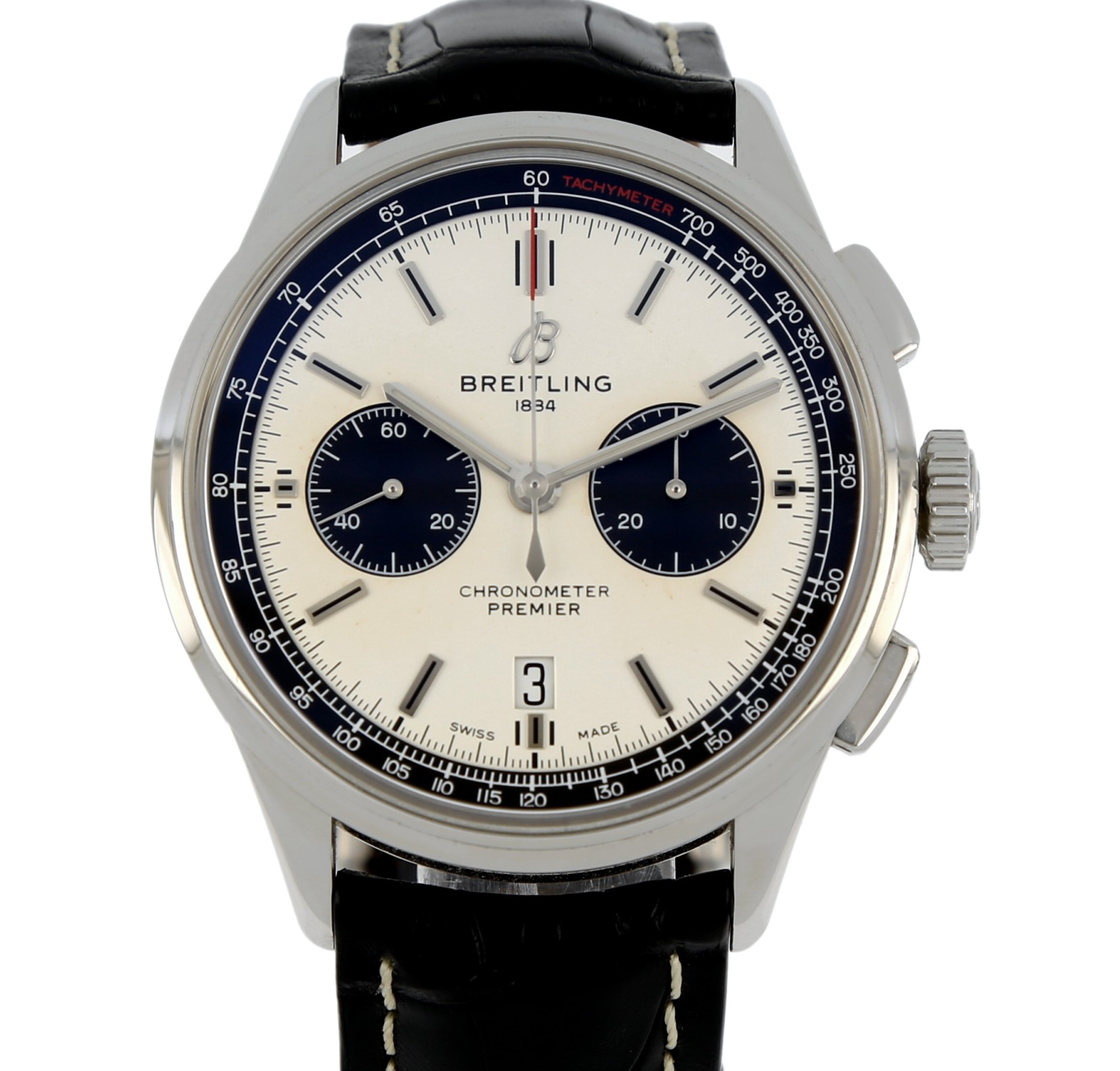
After a long period of absence from the catalogue, the collection is relaunched in 2018 on the occasion of important brand anniversaries, bringing back into production a refined vintage aesthetic with proportions closer to contemporary tastes: clean dials, leaf hands, steel or red gold cases and a Milanese mesh or leather bracelet that explicitly recalls the sartorial taste of the 1940s and 1950s.
In the current range the Premier exists in several configurations, from the base three-hand model to reissues of historic complications: the Premier B15 Duograph takes up the original split-seconds function, while the Premier B25 Datora reintroduces the full calendar and moon phases, confirming the line as the space in the Breitling catalogue dedicated to classic elegance rather than technical instrumentation.
Technical Specifications
Main Executions
The Premier remains Breitling's only major historic line not born from an aeronautical or underwater need: its reason for being, since 1943, is purely aesthetic — an almost unique case in the catalogue of a brand that has built its identity around professional instrumentation.