

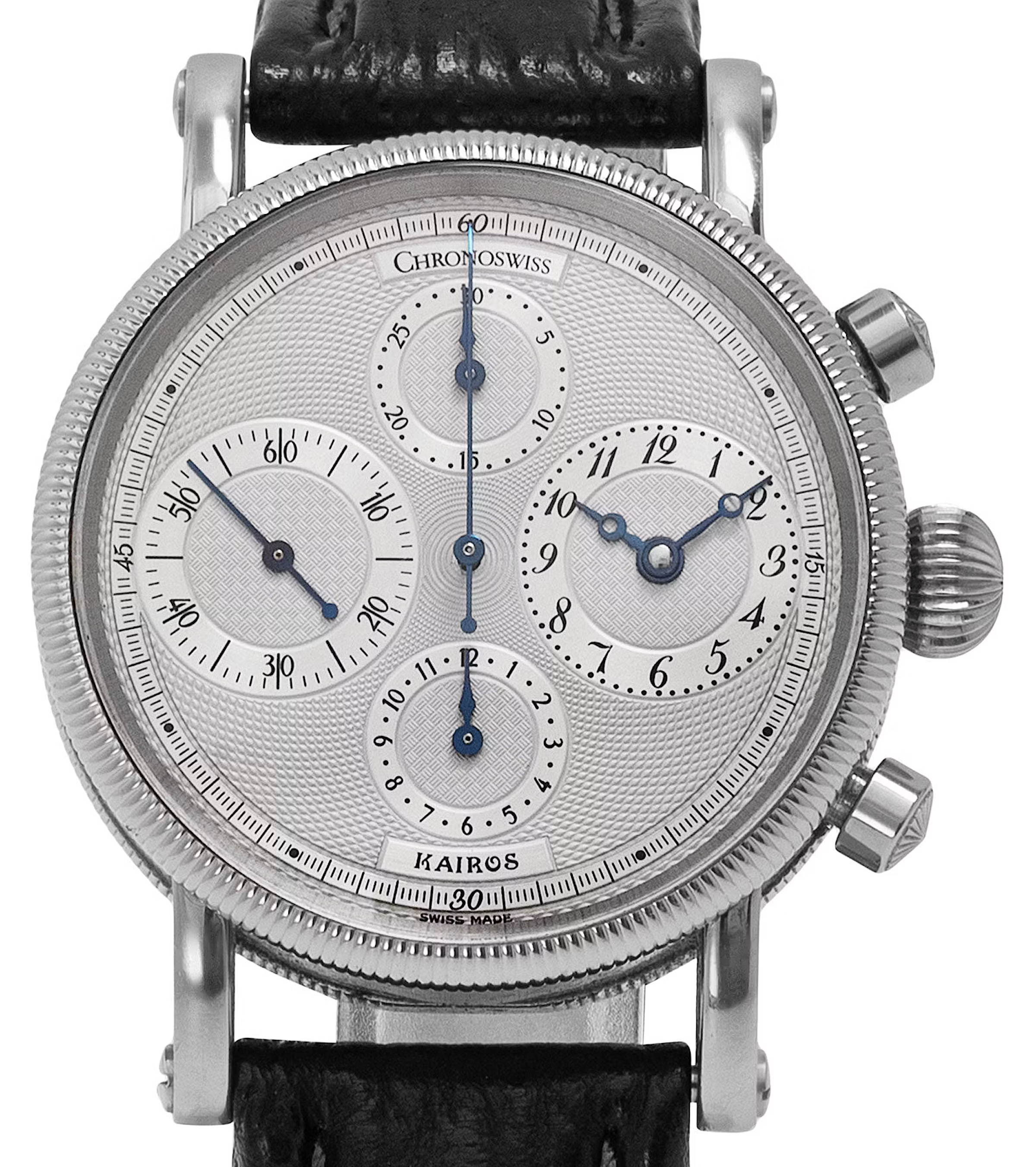
Kairos
Model History
Launched in 1989, two years after the Régulateur, the Kairos was conceived as the more "generalist" expression of the aesthetic language Chronoswiss had just defined: the same onion crown, the same knurled bezel, the same straight lugs with visible screws, but applied to a more conventional dial, with three hands arranged in the classic layout or, in the chronograph versions, with symmetrical counters recalling late-19th-century pocket watches. The name, which in ancient Greek denotes the "opportune moment" to act, reflects the ambition of offering an accessible mechanical watch precisely at the moment when traditional mechanics were slowly coming back into favor.
Over the course of the 1990s, the Kairos became the broadest line in the Chronoswiss catalogue, expanding with Lady and Medium variants designed for smaller wrists, alongside solid or plated gold executions for a more exclusive positioning. It was also one of the brand's first models to feature, in certain references, the chronograph complication, which stood alongside the three-hand layout without ever abandoning the silvered (argenté) dial finish with a raised minute circle, another distinctive detail of the line.
Unlike the Régulateur, which remains a very specific style statement, the Kairos has served Chronoswiss as an "entry point" to the brand: a watch recognizable in its construction details but more immediate to read on the dial, which allowed the brand to broaden its audience without diluting the neo-classical identity built around the onion crown and knurled cases.
Technical Specifications
Main Executions
The name Kairos draws on a concept from ancient Greek philosophy distinct from "Chronos": while Chronos denotes chronological, measurable, sequential time — fittingly the name chosen for the brand as a whole — Kairos designates the "right" or opportune moment to act, a qualitative sense of time that the brand chose to associate with its most accessible and widely produced model.