

Model History
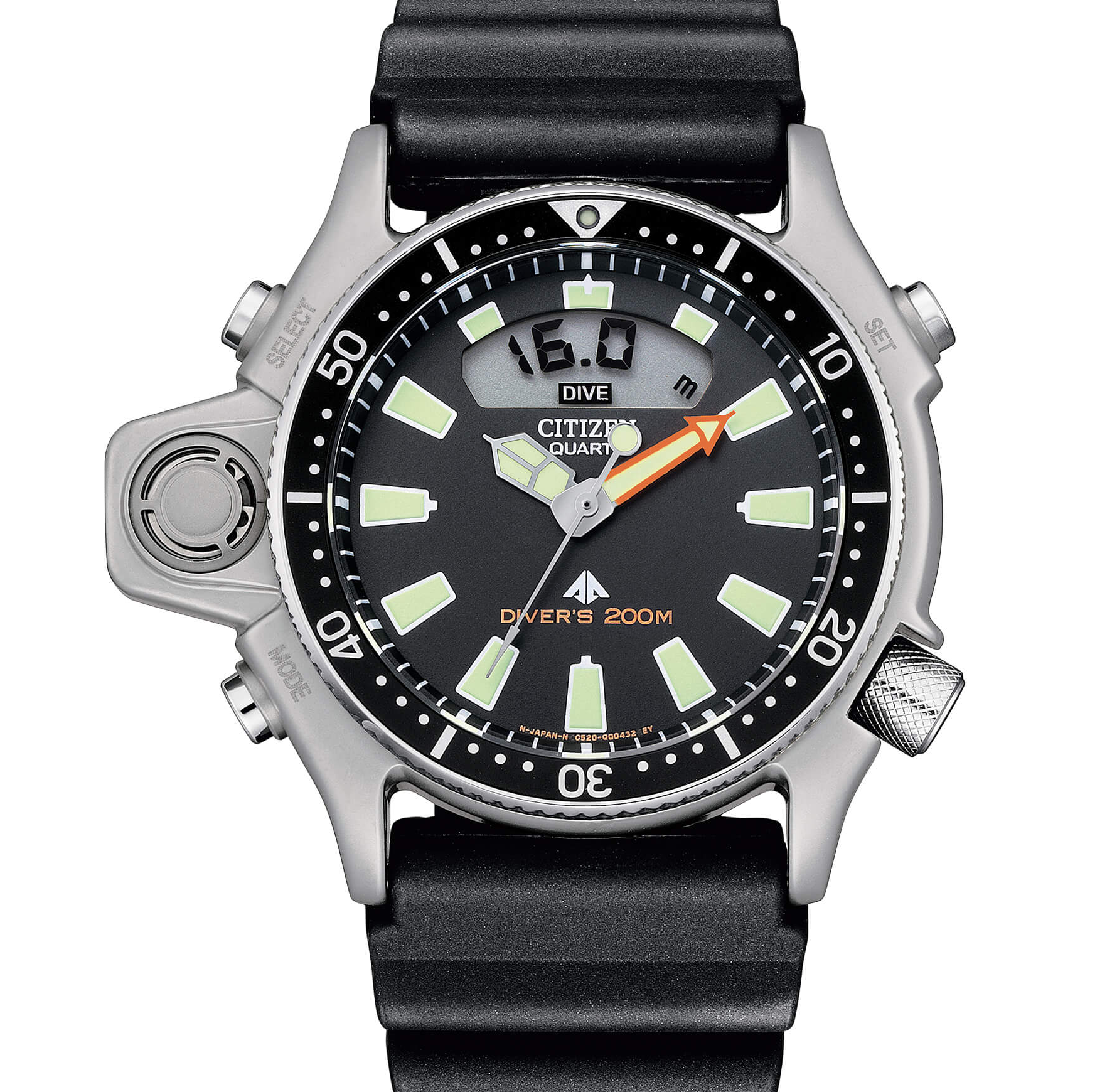
In 1985 Citizen presented the Aqualand, reference C0023, hailed by press and collectors as the first quartz watch fitted with an integrated digital electronic depth gauge: a real bridge between the traditional analog diver's watch and the dive computers then still in their infancy. The 50 mm matte steel case, deliberately asymmetrical in profile to house the sensor module on the left side, paired an analog dial with a digital LCD display — a hybrid solution with no real precedent on the market.
The sensor was calibrated for depths up to 80 meters, with a declared maximum deviation of 3%, while the case's water resistance reached 200 meters. The functions were not decorative: a dive log, depth and time alarms, and a 24 mm black rubber strap printed with decompression tables, meant to be genuinely consulted underwater. The original C020 caliber was replaced in 1988 by the C022, likely to refine the system's reliability.
The most significant leap came in 1992 with the JP2000 reference: externally nearly identical to the C0023, but internally overhauled in depth — a single battery instead of three, a screw-down caseback instead of the original six screws, and the C520 caliber with memory for four complete dives and a calendar extended to 2099. In the following years the family expanded with variants such as the AL-0000-04E, reading depth via analog hands, and the JP-1010, with dual LCD display. In 2025 Citizen celebrated the Aqualand's 40th anniversary with a limited Promaster edition that revives its original design language, confirming its status as an instrument icon of the brand.
Technical Specifications
Main Executions
The value gap between old and new tells the Aqualand's story well among collectors: a current model in the line can still be found for under $400, while an original 1985 C0023 in excellent condition can exceed $1,200 on the vintage market — a rare premium for a watch born as a simple work tool, not as a collector's piece.