
Model History
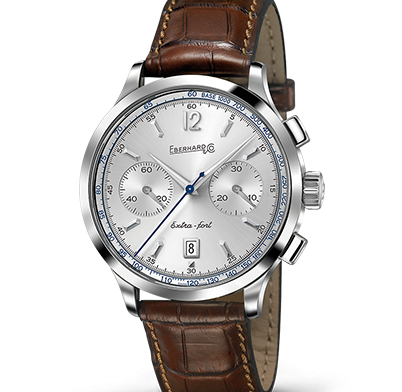
The Extra-fort was born in the 1940s as a direct evolution of the chronograph tradition Eberhard had built over the previous two decades, from the early-century single-pusher wrist chronographs to the later two-pusher and split-seconds mechanisms. The name, which literally means "extra sturdy" in French, faithfully describes the model's spirit: a case designed to withstand everyday use, in keeping with the officers and motorsport enthusiasts who even then made up a significant part of the brand's audience.
The feature that made the Extra-fort recognizable from the start was the slide pusher positioned on the side of the case, a device never before seen on a chronograph of the era and designed to record intermediate times without having to stop the ongoing measurement. The first examples used the Valjoux-derived caliber 16000, replaced from 1951 onward by the more widespread caliber 14000, which accompanied the model through most of its subsequent history.
Over the decades the Extra-fort has been reinterpreted several times: from the automatic version introduced in the early 2000s to the column-wheel Grande Date designed to prevent accidental resets, up to the 41 mm Grande Taille with an automatic ETA 7750 base caliber. Beyond the individual executions, the Extra-fort is still regarded as the direct precursor of all the brand's later "sporty chic" chronographs, the model from which Eberhard & Co.'s entire modern chronograph production ideally descends.
Technical Specifications
Main Executions
The Extra-fort's slide pusher is so central to the brand's identity that, even today, the contemporary versions most faithful to the original spirit reproduce it as a direct nod to the vintage examples from the 1940s and '50s, much sought after by collectors of military and sports chronographs of that era.