

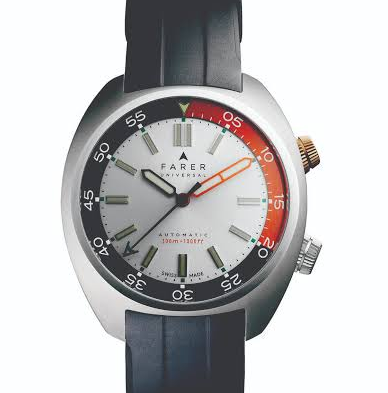
Aqua Compressor
Model History
Introduced in September 2017, the Aqua Compressor was one of the first automatic collections dedicated to diving in the Farer catalogue. The case, with its 1970s-inspired cushion profile, adopts the "Super Compressor" construction devised in the 1960s by the Swiss maker E. Piquerez (EPSA) and historically used by Longines and Jaeger-LeCoultre as well: a double-crown system in which the caseback compresses against a gasket as pressure increases, boosting water resistance with depth.
The line's first three models were named after Royal Navy research ships used in 19th-century scientific and polar expeditions: Endeavour, with a matte black dial and luminous bezel; Hecla, with a three-layer blue dial and wave engravings; Leven, with a silver sunburst dial and a decompression scale on the inner bezel. All were fitted with the automatic ETA 2824-2 movement in a date-free configuration, for a rated water resistance of 300 metres.
In 2025 the collection was renewed: the case moved from steel to lighter grade 2 titanium, and the movement was replaced by the La Joux-Perret G101 automatic calibre, with 68 hours of power reserve. The screw-down crowns kept their characteristic bronze caps, while the dials now use the new Super-LumiNova X2; part of the collection's proceeds goes to the Hebridean Whale and Dolphin Trust, a British cetacean conservation charity.
Technical Specifications
Main Executions
The names Endeavour, Hecla and Leven belong to real Royal Navy vessels used in 19th-century scientific and polar expeditions — in keeping with Farer's taste for naming its watches after real ships and explorers rather than invented names.