

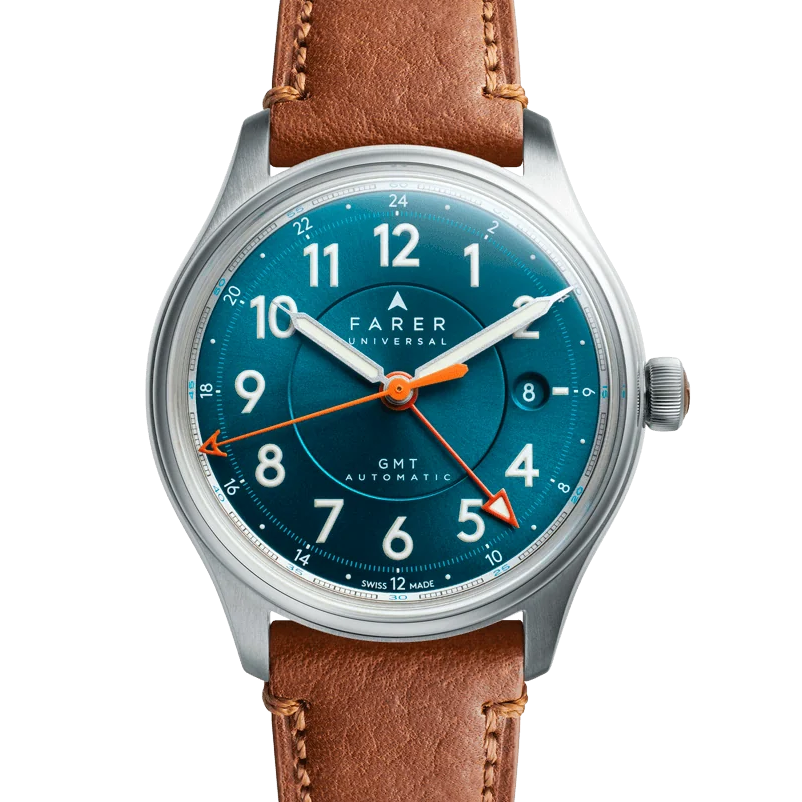
GMT
Model History
Introduced in 2017, the GMT collection was among the first automatic "travel" lines in the Farer catalogue: a watch designed for those living across multiple time zones, fitted with a dedicated GMT hand that makes one full rotation every 24 hours. The early series were powered by the automatic ETA 2893-2 movement, one of the most widely used GMT calibres in mid-range Swiss watchmaking.
The line's distinguishing feature is the 24-hour scale printed on the outer edge of the dial, often two-tone in "Pepsi" style but reinterpreted with colour combinations unusual for the genre, paired with bold dial colours and model names recalling real places and explorers. Several references forgo the traditional rotating bezel altogether, leaving the second time zone to be read solely from the dedicated hand against the fixed dial scale.
Over time the range has been renewed several times, reaching its most recent generation — represented by the Lander IV model — with the Sellita SW330-2 "Top Grade" movement and a 316L steel case measuring 39.5 mm, also available in a more compact 36 mm version, alongside references such as Nevada, Crooms and Maze. The GMT collection remains one of the brand's largest families today, alongside its GMT Bezel and World Timer offshoots.
Technical Specifications
Main Executions
Unlike many traditional GMT watches, several references in the line have no rotating bezel: the second time zone is read from a fixed scale printed on the edge of the dial, indicated by the dedicated GMT hand — a solution that simplifies the case construction without giving up the travel function.