

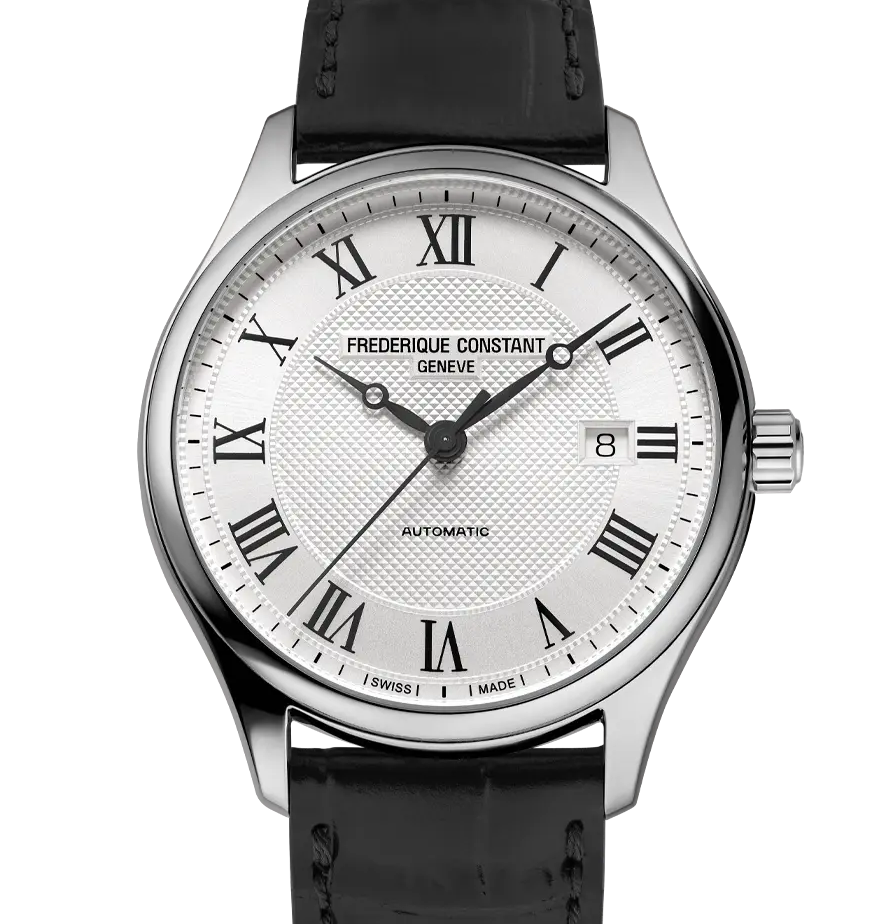
Classics
Line History
The Classics collection traces its roots to 1994, when Frédérique Constant presented its first Heart Beat: a watch with a classic, round dial, made unique by a small opening at 12 o'clock that reveals the balance wheel oscillating, like a mechanical "heartbeat" on view. At the time it was a feature few other brands offered with such ease, and over time it would become the image most associated with the Geneva brand, reprised across countless variants of case, dial and complication over the following decades.
Classics remains, in today's catalog, the brand's broadest and most varied line: it includes three-hand executions, chronographs, moon phases and increasingly sophisticated complications, while keeping a round, elegant case design that sets it apart from the sportier language of the Highlife. It was in this line that the Worldtimer Manufacture debuted in 2012, fitted with caliber FC-718, which allows all the multiple-time-zone functions to be set using only the crown, with no auxiliary pushers — a technical solution the brand presents as one of its most significant patented innovations.
Precisely because it represents the collection most layered over time, Classics remains the main ground on which Frédérique Constant has built, movement after movement, its path toward production verticalization: from the first manufactured caliber of 2004 to its more recent perpetual calendars and tourbillons, it is in this "generalist" line that much of the brand's technical evolution finds its first application, before sometimes being carried over to other collections as well.
Technical Specifications
Main Executions
The Heart Beat opening, today an almost textbook feature in accessible watchmaking, was considered an unusual solution at the time of its debut: showing the balance wheel — normally hidden beneath the dial — was a way to make the watch's mechanics visible and "tellable" even to a non-specialist audience, consistent with the mission of making Swiss watchmaking more understandable and accessible.