

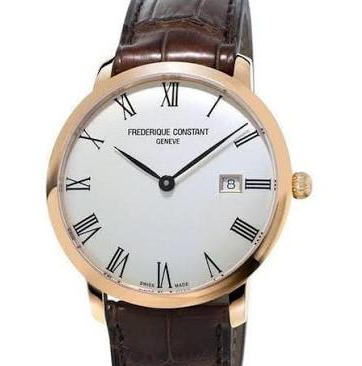
Slimline
Line History
Slimline is Frédérique Constant's historic answer to the more formal register of dress watchmaking: round cases with a low profile, understated dials, leather straps, designed for a more ceremonious use than the sporty language of the Highlife or the more eclectic Classics. It is a line that has accompanied the brand's catalog since its earliest years of activity, offering an elegant, slim alternative to thicker, more instrument-like executions, and which over time has also housed notable complications such as the manufacture perpetual calendar, offered in a thin case precisely so as not to betray the collection's "dressed wrist" vocation.
The line's most significant turning point came in 2021, when Frédérique Constant presented the Slimline Monolithic Manufacture: a watch that replaces the traditional balance-and-spring regulating system with a monolithic silicon oscillator, made from a single piece machined using DRIE (Deep Reactive Ion Etching) technology, the same used to produce high-precision silicon microcomponents. The result is a regulating organ free of traditional mechanical friction, whose oscillation is made visible through an opening on the dial at 6 o'clock, in ideal continuity with the Heart Beat opening tradition that has characterized the brand since 1994.
With the Monolithic Manufacture, Slimline stops being simply the "dress" line of the catalog and becomes the platform on which Frédérique Constant demonstrates its research capability in materials and regulating systems, ground usually associated with manufactures of a much higher tier: a positioning the brand explicitly claims as proof of its technical independence, reinforced since 2016 by the industrial support of the Citizen group.
Technical Specifications
Main Executions
The DRIE technology used to machine the Slimline's monolithic oscillator belongs to the same family of processes used in the semiconductor industry to etch silicon microcomponents with extreme precision: a technological field quite far removed from traditional watchmaking, which Frédérique Constant chose to apply to a regulating organ in order to replace hundreds of years of balance-spring mechanics.