

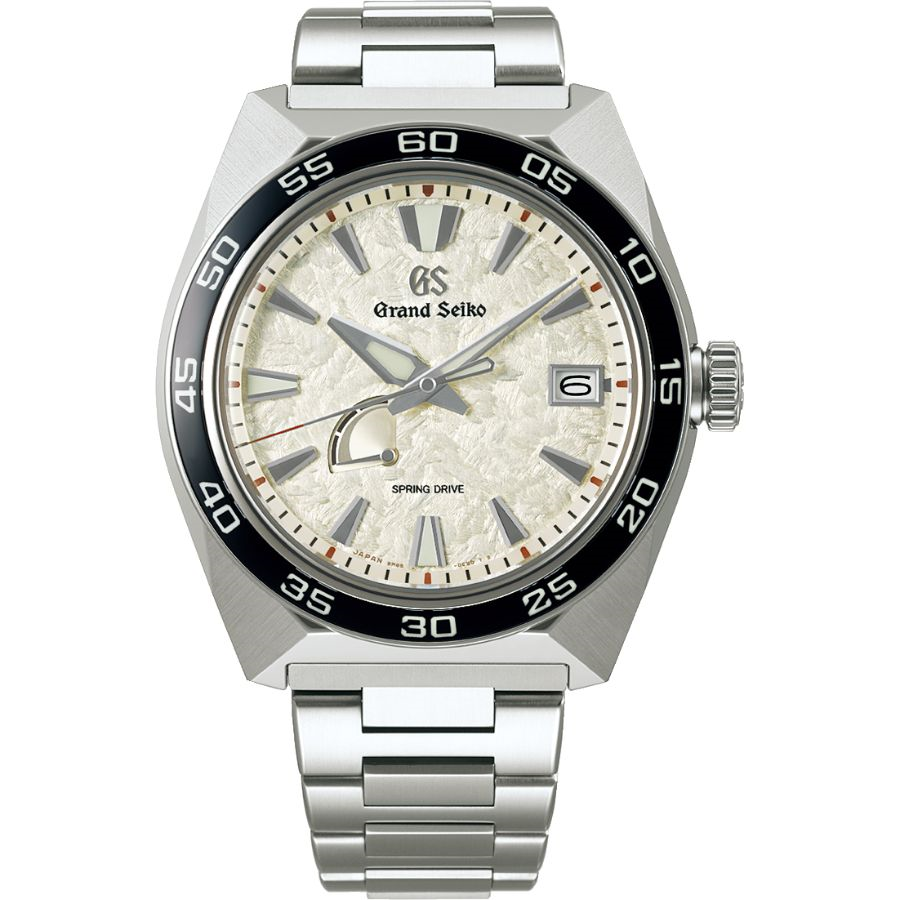
Sport Collection
Line History
If the Heritage Collection tells the origins of Grand Seiko and Spring Drive its most original technological pursuit, the Sport Collection tells the brand's more recent, more explicitly competitive side: the one that, upon becoming independent from Seiko in 2017, chose to compete openly with great Swiss sports watchmaking, including in professional divers and travel chronographs. The collection officially debuted in 2017, but its technical roots run back more than two decades: the return of Grand Seiko mechanical movements in 1998 with the caliber 9S55, the introduction of the first GMT models in 2002, and the arrival of Spring Drive in 2004 had already laid the technical groundwork — reliable automatic winding, dual time zone, electro-mechanical precision — on which the Sport Collection could build a range devoted entirely to those seeking a watch that is rugged, legible and resilient before it is refined in the classical sense.
The model symbolizing this debut is the Hi-Beat 36000 Professional 600m Diver, presented in March 2017: the first true mechanical diver in Grand Seiko's history as a standalone brand. Until then, Seiko's experience with professional divers — built up since the 1960s with the celebrated references 6215 and 6159 and later with the "Tuna" series designed by Ikuo Tokunaga in the mid-1970s — had remained largely separate from the Grand Seiko brand, which was more devoted to desk-top precision than extreme use. The new diver united the two traditions: the high-frequency automatic caliber 9S85, beating at 36,000 vibrations per hour for a particularly smooth sweep of the seconds hand, is housed in a high-strength titanium case rated to 600 meters, with an L-shaped gasket, a screwed case back and — a distinctive technical solution compared with professional divers that fit a helium escape valve — a case construction airtight enough not to need one.
Alongside the divers, the Sport Collection has progressively expanded its range with GMT models — often inspired by Japanese natural landscapes reproduced on two-tone bezels, in an aesthetic that openly echoes the brand's beloved tradition of "landscape" dials — and with Spring Drive chronographs, among the most elaborate complications Grand Seiko has ever produced: chronograph, GMT and power reserve coexist in the same 9R movement, in angular, faintly aggressive cases that enthusiasts have nicknamed "Tokyo Lion" since their debut in 2019, with squared, claw-shaped lugs and diameters that in some cases exceed 44.5 mm.
Unlike the Heritage Collection, where every detail refers philologically back to 1967, the Sport Collection is the showcase where Grand Seiko applies its own Grammar of Design — flat surfaces, crisp angles, Zaratsu polishing even on large cases and in complex materials like titanium — to a contemporary language built for intensive daily use rather than formal elegance: proof, explicitly intended by the brand since its launch as an independent company, that Japanese precision and aesthetics can coexist with the resilience demanded of a high-end sports watch.
Technical Specifications
Main Executions
To design Grand Seiko's first mechanical diver, designer Shinichiro Kubo personally dove multiple times to test the legibility of the bezel and indexes in the field: a hands-on, almost test-pilot approach unusual for a brand that until then had built its reputation chiefly on caliber and desk-top finishing.