

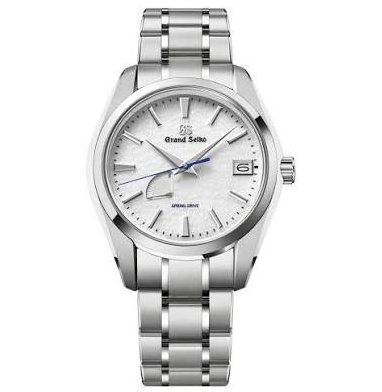
Spring Drive "Snowflake"
Line History
Spring Drive is, together with the Grammar of Design, the second great invention with which Grand Seiko built its independent identity apart from Swiss watchmaking. The idea was born in 1977 in the mind of Yoshikazu Akahane, a young engineer at Suwa Seikosha, dissatisfied both with the limited precision of traditional mechanical escapements and with the "coldness" of quartz: his goal was a movement that retained a genuine mechanical power source — a mainspring that winds and transmits energy through a gear train — while replacing the lever escapement, a source of friction and imprecision, with electronic regulation capable of delivering quartz-level accuracy. Turning this idea into reality proved anything but simple: it took roughly twenty years of research, with numerous abandoned prototypes, before the project reached an industrializable form.
At the heart of the final solution is the so-called "Tri-synchro Regulator," a system that performs three functions at once: it controls the release of mechanical energy stored in the mainspring, generates a small electric current that powers a reference quartz oscillator, and uses that same current to create a magnetic brake that precisely regulates the rotation speed of the "glide wheel" in place of a traditional balance wheel. The most visible practical result, and the one enthusiasts love most, is a seconds hand that doesn't tick but glides continuously and perfectly smoothly across the dial — a visual effect impossible for either a classic mechanical movement or a quartz one. First shown in experimental form in 1997 and presented to the public at the 1998 Basel fair, Spring Drive debuted commercially in 1999 and was permanently adopted by Grand Seiko in 2004 with the automatic caliber 9R65.
It is precisely on a Spring Drive movement that, in autumn 2005, the model that would become the brand's most photographed icon was born: reference SBGA011, nicknamed "Snowflake" by enthusiasts for a dial that reproduces the texture of fresh snow. The inspiration came from the landscape the artisans at the dial-making studio in Shiojiri, in Nagano prefecture, observed from their workstations for much of the year: the snow-covered peaks of the Shinshu highlands. To reproduce that texture without resorting to paint, the artisans developed a silver process carried out in roughly 80 increasingly intricate steps, yielding a granular surface that catches the light differently at every angle, just like real snow.
When Grand Seiko became a standalone brand in 2017, the informal nickname "Snowflake" was officially adopted and the model returned to the catalog under the new reference SBGA211, with a 41 mm titanium case finished with Zaratsu polishing even on surfaces usually reserved for steel — no small technical feat, since titanium is harder to mirror-polish without compromising its lightness. Since then, the Snowflake texture, and more broadly the Spring Drive platform that powers it, has become, for the general public, the image most immediately associated with the brand, just as the Grammar of Design is for enthusiasts of classical watchmaking.
Technical Specifications
Main Executions
The name "Snowflake" was never chosen by a marketing department: it arose spontaneously among online collectors who, even before the official 2017 launch, used that nickname to describe the dial of reference SBGA011. Grand Seiko simply recognized and adopted a name the public had already chosen for it.