

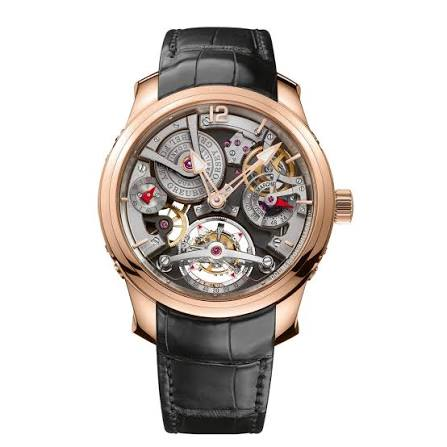
Double Tourbillon 30°
Line History
The Double Tourbillon 30° is the first watch to bear the Greubel Forsey name, presented in 2004 and considered the brand's founding act: Robert Greubel and Stephen Forsey built an initial prototype of the mechanism using actual Meccano pieces, to verify the invention's geometry before moving on to execution in precious metal. The starting idea was to push beyond Abraham-Louis Breguet's traditional tourbillon, conceived in 1801 for pocket watches that were essentially stationary, adapting it better to the constant changes of position of a wristwatch.
The solution patented by the two founders places a tourbillon cage tilted 30 degrees, completing one rotation per minute, inside a second horizontal cage that instead rotates once every four minutes: the combination of the two motions means the regulating organ passes through a much wider range of spatial positions than a single tourbillon, averaging out rate deviations caused by gravity more effectively. The result is visual as well as technical: the wide fan-shaped opening on the dial reveals the choreography of the two moving cages.
Over the years the Double Tourbillon 30° has been reinterpreted in several executions — including Vision, with an even wider dial opening, Technique, Asymétrique, and the Édition Historique in 5N red gold, the latter honored with the Grand Prix de l'Aiguille d'Or in 2010 — remaining for years the manufacture's most representative caliber, until production was gradually scaled back toward the end of the 2010s in favor of later inventions, such as the Quadruple Tourbillon and the GMT family.
Technical Specifications
Main Executions
Before producing the final caliber in metal, Greubel and Forsey tested the geometry of the two tourbillon cages with a prototype built from Meccano pieces: an almost homespun craft detail at the origin of one of the most expensive and complex watches ever produced in series.