

Line History
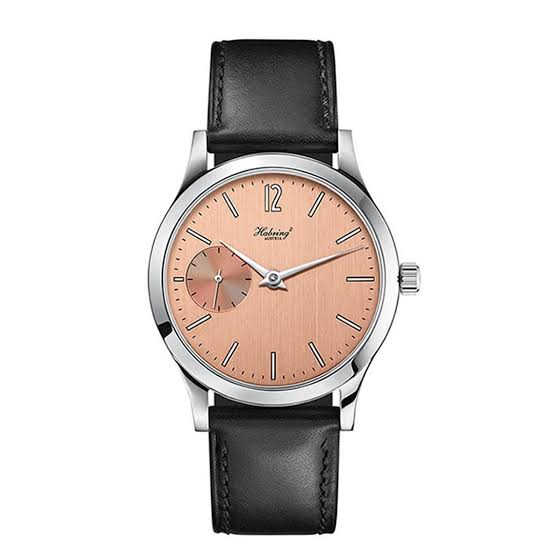
Presented in 2014, coinciding with the tenth anniversary of the manufacture's founding, the Felix marks an important milestone in the history of Habring2: it is the first watch from the manufacture to house a movement — the A11 caliber — developed and assembled entirely in Austria, rather than derived from a modified Swiss mechanical base. The A11 caliber is made up of roughly 180 components sourced from Austrian, German and Swiss suppliers, with a chronometer-grade hairspring supplied by Carl Haas, and has been described by several industry observers as among the first modern mechanical movements designed and produced entirely on Austrian soil.
The model earned significant recognition for a manufacture of such modest size, winning the Petite Aiguille prize at the 2015 Grand Prix d'Horlogerie de Genève, dedicated to mechanical watches that are accessibly priced yet of high artisanal quality. The case's compact dimensions (38.5 mm) and the dial's understated layout reflect the Habrings' wish to offer an essential "time and date" watch, conceived as the base for the entire family of calibers that would be derived from it.
Starting from the A11 caliber, the Felix family has progressively grown with variants featuring additional complications grafted onto the same base architecture: the Chrono-Felix, with a single-button (monopusher) chronograph, and the Foudroyante-Felix, which adds to the A11 base a complication linked to the measurement of intermediate times. The Chrono-Felix, in particular, has also become known for its "Panda" dial version — light background with dark counters — much appreciated by enthusiasts.
Technical Specifications
Main Executions
With the Felix, Habring2 chose to celebrate its first ten years of activity not with a special reference on a Swiss base, but with a movement conceived and built from scratch in Austria: a choice consistent with the manufacture's identity, which has always claimed its independence from Swiss industrial circuits as part of its positioning.