
Hanhart
Brand History
Hanhart was founded on 1 July 1882 in Diessenhofen, on the Swiss Rhine, where Johann Adolf Hanhart opened a retail watchmaking shop. In 1902 the business moved to Schwenningen am Neckar, at the time the most important watchmaking center in Germany, in the Black Forest. In 1920 his son Wilhelm Julius Hanhart joined the company, opening a period of intense innovation: in 1924, after finding himself faced with the high price of Swiss stopwatches at a sporting event, he launched what the company describes as the world's first affordable mechanical stopwatch. In 1926 production expanded to pocket and wrist watches, and in 1934 a second plant opened in Gütenbach, also in the Black Forest.
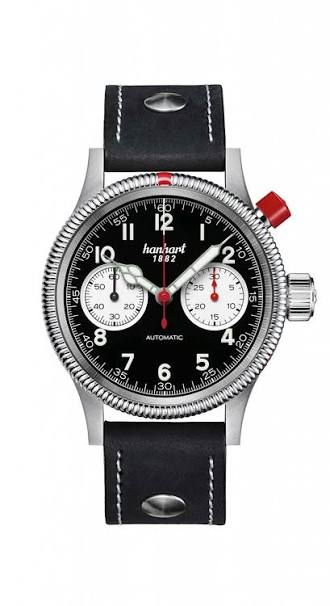
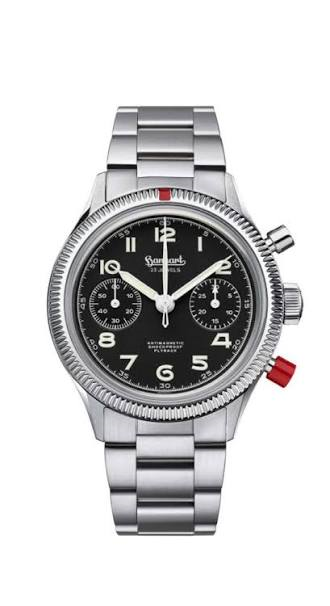
In the late 1930s Hanhart entered the world of true chronographs: in 1938 the Calibre 40 debuted, a single-button chronograph, followed in 1939 by the Calibre 41 for pilot's chronographs, some fitted with a pusher lacquered red to prevent accidental resets — a detail that, according to brand tradition, originated when a pilot's wife painted her husband's pusher red, and which would later become Hanhart's most recognizable signature feature. In these same years, and throughout the Second World War, the company supplied chronographs to the German armed forces, including the Luftwaffe and the Kriegsmarine: a chapter of history that the brand openly acknowledges today as part of its own story, including the National Socialist period.
After the war, with Willy Hanhart's return in 1948, production resumed with the "Admiral" chronograph for the French armed forces. In 1957 came supplies of the new Calibre 42 to the Bundeswehr and to other Western European air forces, in the 417 E and 417 ES models. In the 1960s Hanhart became the largest European producer of mechanical stopwatches, before facing, like most of the industry, the transition to quartz starting in 1972. In 2014 a group of entrepreneurs — led by co-CEOs Simon Hall and Felix Wallner — took over the wristwatch division, later bringing stopwatch production together under the same roof in Gütenbach: a relaunch built on explicitly "Made in Germany" wristwatch production, while keeping the historic registered office in Diessenhofen.