

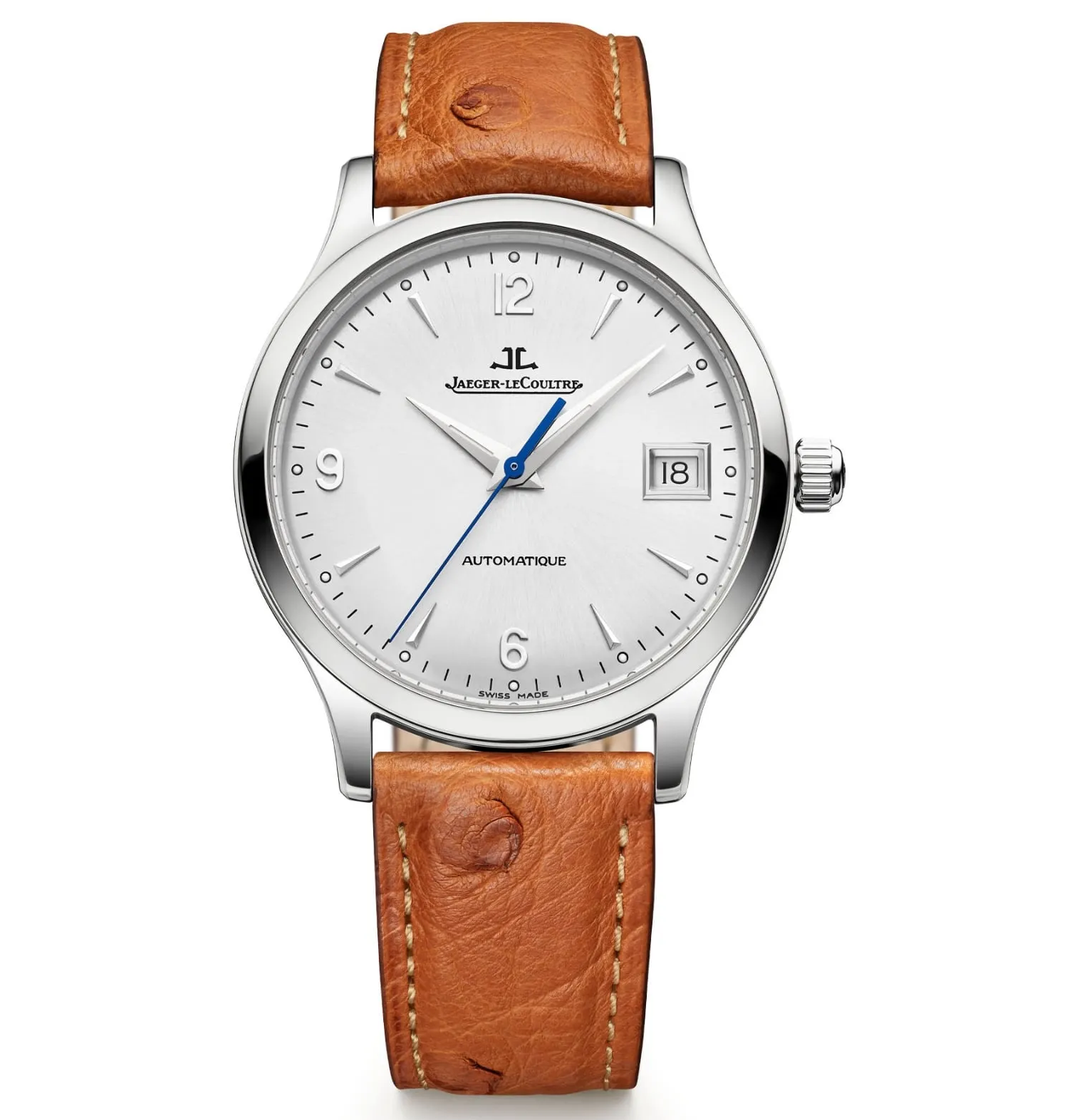
Master Control
Model History
The Master Control is born in 1992, at a time when Swiss mechanical watchmaking is regaining ground after the quartz crisis and the great manufactures are once again focusing on their own technical identity. Jaeger-LeCoultre responds with a collection designed to embody, without flashy complications or eccentric stylistic choices, the house's pure manufacturing philosophy: round cases, sober dials, dauphine hands, all built around calibres developed and produced entirely in Le Sentier. Every piece in the line is subjected to a testing protocol unprecedented for its time, the "1000 Hours Control": not a simple test of the bare movement, as was traditionally done, but a check of the fully assembled watch — case, dial and strap included — put through precision, water-resistance and durability tests under conditions that replicate everyday wear for a period equivalent to roughly 1,000 hours, just over forty days.
Behind the apparent simplicity of the Master Control's forms lies a technical legacy that dates back decades earlier: already in 1907 Jacques-David LeCoultre had developed Calibre 145, the thinnest mechanical movement ever made up to that point, taking up the challenge issued by Parisian watchmaker Edmond Jaeger. It is on this know-how in miniaturization and calibre reliability that the collection builds its identity, branching out over time into different families: alongside the Master Control Date, the three-hand-and-date model that started it all, come the Master Calendar with full calendar and moon phases, and more recently the Master Ultra Thin sub-line, which pushes the thinness heritage of Calibre 145 to the extreme.
The technical heart of the contemporary collection is the in-house Calibre 899, refined several times over the years to improve energy management and reach, in its most recent versions, up to 70 hours of power reserve. It is no coincidence that current models, such as the Master Control Classic presented in 2025, directly echo the design of a 1995 model: the collection has built its strength precisely on continuity, keeping the same aesthetic language — argenté dial, applied indices, railway minute track — for over thirty years, while the movement powering it was constantly updated.
Technical Specifications
Main Executions
The "1000 Hours Control" protocol devised for the collection's 1992 launch represented an absolute novelty in the industry: while most brands only tested the movement before assembly, Jaeger-LeCoultre chose to test the finished watch, strap included, replicating real-world usage conditions for the equivalent of over forty consecutive days before it could leave the manufacture.