

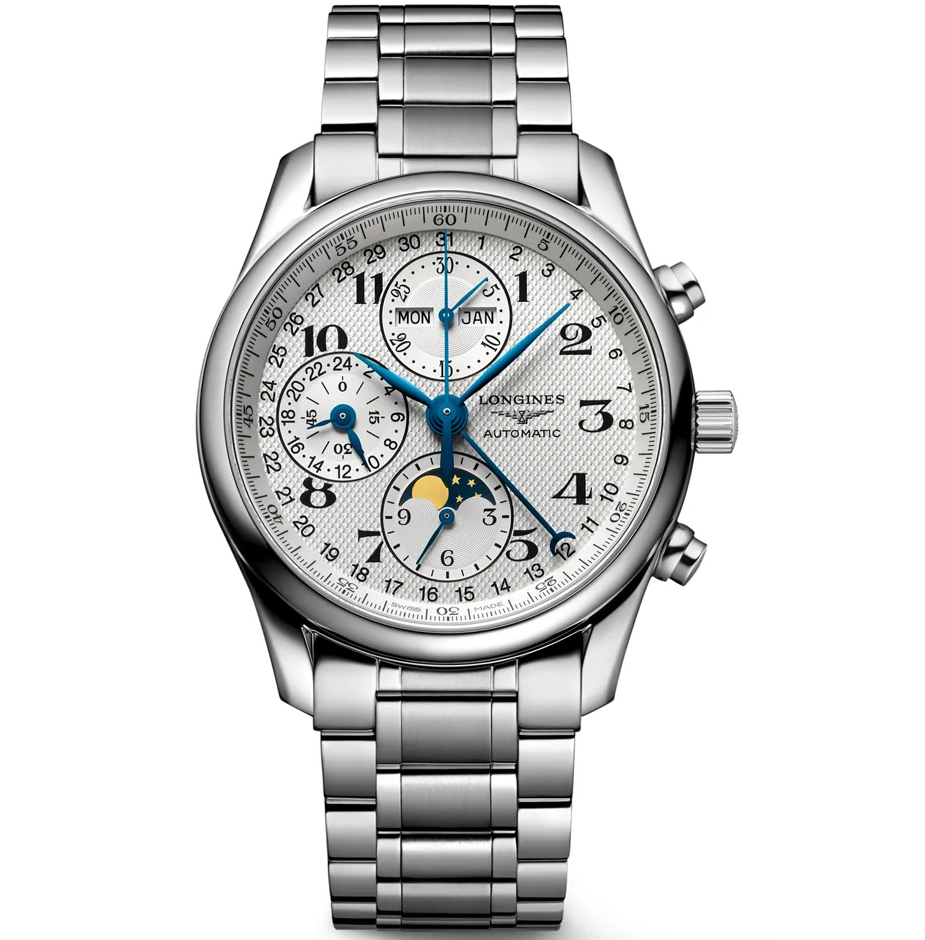
Master Collection
Model History
The Master Collection was born in the mid-2000s as Longines' response to the need, within a very broad catalogue fragmented into dozens of families, for a single collection able to fully embody the brand's idea of a "classic" watch: measured proportions, a clean and legible dial, a reliable automatic movement, all without giving in to either excessive decoration or an overly sporty language. The name itself — "Master" — is a declared homage to Saint-Imier's manufacturing tradition and a claim to represent its most accomplished synthesis.
The line's most recognizable distinctive feature is the case with three articulated lug elements, a construction solution that recalls early twentieth-century fine watchmaking jewelry, and which has from the start made it possible to tell a Master Collection apart from any other model of the brand at a glance. Alongside this is a vocabulary of recurring details found on most of the dials: applied Roman or baton numerals, triangular date windows (a small graphic invention that has become almost a trademark of the line) and, on the more refined models, a guilloché or "barleycorn" dial that recalls historical artisanal craftsmanship.
Over the years the Master Collection has been enriched with increasingly sophisticated complications — moon phases, annual calendars, small seconds, chronographs with triple semicircular counters — while maintaining a relatively accessible price for the level of finishing offered, thanks to the use of industrial mechanical bases from the Swatch Group (the L888 and L899 caliber families, derived from ETA/Valjoux architectures) reworked with silicon hairsprings and chronometric certifications. In 2022, on the occasion of the brand's 190th anniversary, Longines presented a series of renewed editions of the line, confirming its role as the flagship collection alongside more specialized offerings such as Spirit or HydroConquest.
Technical Specifications
Main Executions
The three articulated lug elements of the Master Collection are not just an aesthetic flourish: they derive from construction solutions used on early twentieth-century wrist and pocket watches preserved in the Longines historical archive in Saint-Imier, and were chosen precisely to build a direct visual bridge between contemporary models and the brand's output from its pioneering decades.