

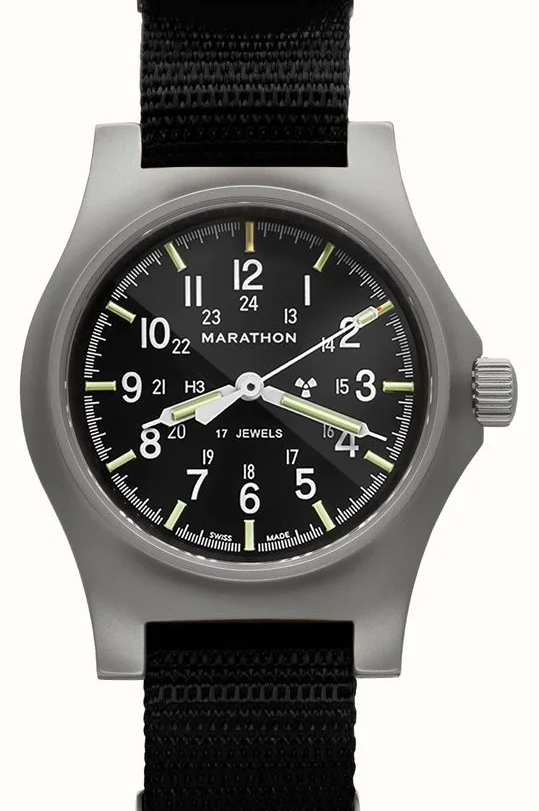
General Purpose
Model History
The roots of the General Purpose go back to the GG-W-113 standard, adopted by the US armed forces in the 1960s to define a simple, rugged and inexpensive field watch that could be supplied on a large scale to ground troops during the Vietnam War. While many American manufacturers gradually abandoned this segment in subsequent years, Marathon remained among the few to keep building watches faithful to that essential approach, progressively updating its technical specifications alongside new Department of Defense standards.
The standard in force today, MIL-PRF-46374G — adopted in 1999 as the "Performance" evolution of the earlier W-46374 specifications — precisely defines requirements for ruggedness, dial legibility and illumination via tritium markers. The General Purpose Mechanical (GPM), the mechanical variant of the line, was among other things the watch officially under government contract during Operation Desert Storm in August 1990: concrete, not merely claimed, proof of the military supply role the model continues to play.
Alongside the mechanical version, the General Purpose family also includes quartz variants (GPQ), available with or without a date window, designed for personnel who prefer the reliability of a battery-powered movement. The current catalog offers several case sizes — from the more compact and tactical 34 mm, to the 36 mm of the "Officer's" variant, up to the larger 41 mm versions — while always keeping a deliberately spartan setup, designed to be field-repairable rather than to impress aesthetically.
Technical Specifications
Main Executions
The General Purpose Mechanical is not simply a watch "in military style": in August 1990 it was the watch officially under government contract for Operation Desert Storm, a detail that places it among the few models still in production today with documented wartime service behind it, and not merely an ideal kinship with field watches of the past.