

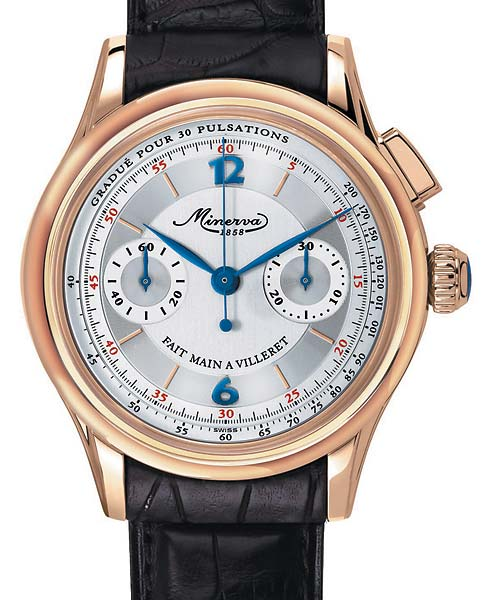
Single-Button Chronograph
Line History
Since 1908 Minerva focused its production on chronographs, but it was in 1923 that the company presented the 13-20 CH calibre, a manual single-button movement built around a column wheel: the mechanical heart that for much of the twentieth century set the quality standard for high-end wrist chronographs. The single-button system, which starts, stops and resets the seconds hand via a single pusher often integrated into the crown, requires extremely precise artisanal work on the column wheel, the component that synchronizes the chronograph's various functions.
Watches built around this calibre, and its later evolutions, were appreciated both for civilian use and in fields where chronometric reliability is essential: from sports timekeeping to aeronautical and military uses, sectors in which the precision of Minerva calibres became a benchmark for the entire industry. The line accompanied the Villeret manufacture for decades, contributing decisively to Minerva's reputation as one of the world's great specialists in the mechanical chronograph.
Produced in several case and dial variants over the decades, the single-button chronograph remains the most identity-defining chapter in Minerva's history as an independent manufacture, long before the name became associated, from 2007, with Montblanc's high-watchmaking collections.
Technical Specifications
Main Executions
The quality of Minerva's single-button calibres is such that, decades later, the same Villeret manufacture — by then already part of Montblanc — would base some of its most celebrated reissues on this column-wheel technology, confirming the soundness of a mechanical architecture conceived almost a century earlier.