

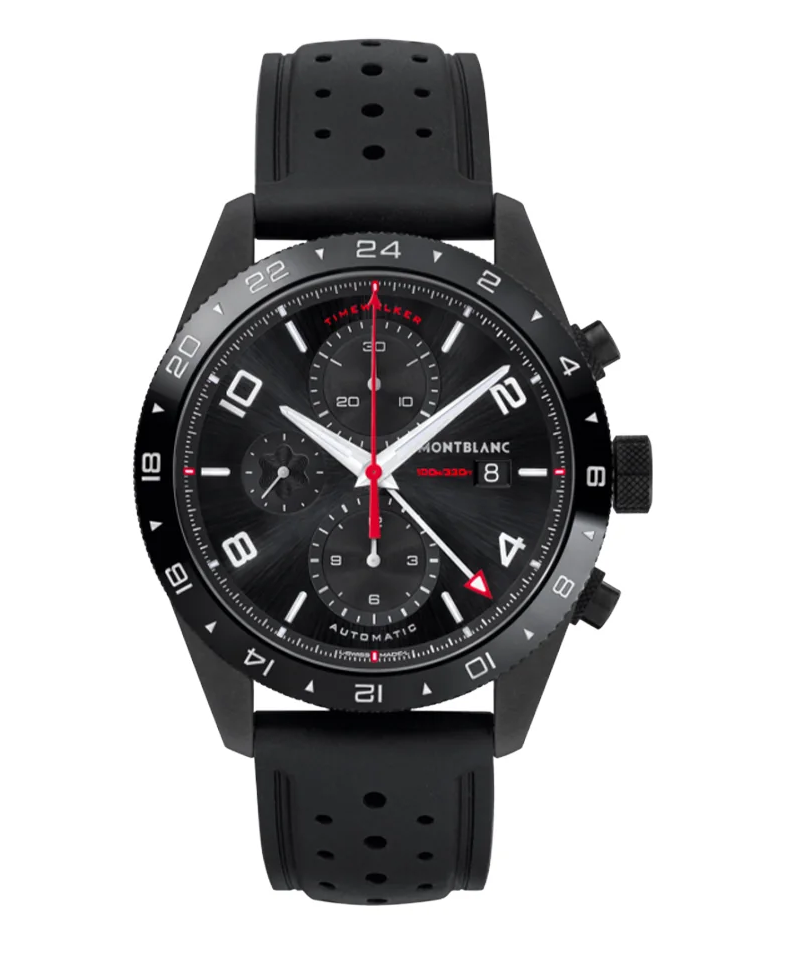
TimeWalker
Model History
The TimeWalker was born in 2003 as Montblanc's answer to a younger, sportier audience than that of the classic collections: dials with a minimal design, numerals and indexes with a squared-off, Bauhaus-inspired cut, and a positioning meant to sit alongside — without overlapping — the more formal elegance of the Star Legacy. For over a decade the line thus accompanied the brand's catalogue as a more informal and accessible option.
The turning point comes in 2017, when the TimeWalker was completely rethought under the direction of Davide Cerrato, then head of Montblanc's watch division: the aesthetic language becomes more aggressive, with bolder cases and a red-and-black contrasting livery explicitly inspired by the world of motor racing and by the sports stopwatches that the Minerva manufacture of Villeret had produced since the nineteenth century for timing races and competitions. It is no coincidence that the collection becomes the main vehicle through which Montblanc tells the "motorsport" side of its Minerva legacy, distinct from the more alpine/historical register of the 1858 and the more formal one of the Star Legacy.
The technical pinnacle of the renewed TimeWalker is the Chronograph 1000 Limited Edition 18, presented that same year, 2017: a double-balance-wheel chronograph capable of measuring the thousandth of a second, with a second balance wheel dedicated to the chronograph oscillating at 360,000 vibrations per hour and read through a fan-shaped window at 12 o'clock — one of the most extreme technical demonstrations ever produced by the Minerva manufacture. Alongside this manifesto piece, the range includes more accessible executions such as the Chronograph Automatic and the Date Automatic (based on modified Valjoux 7750 and Sellita SW500 movements), as well as variants designed for en-route use such as the Chronograph UTC with a bidirectional ceramic bezel for the second time zone, and the surprising Rally Timer Counter, a 50 mm chronograph that transforms from a wrist watch into a dashboard or table stopwatch thanks to folding lugs and retractable feet.
Technical Specifications
Main Executions
The TimeWalker Chronograph 1000's chronograph balance wheel oscillates at 360,000 vibrations per hour, versus the 28,800 or 36,000 typical of most mechanical watches: a rate so high that the device exhausts its dedicated power reserve in just 45 minutes of continuous chronograph use, just like a real competition stopwatch designed to measure fleeting instants rather than run for hours on end.