

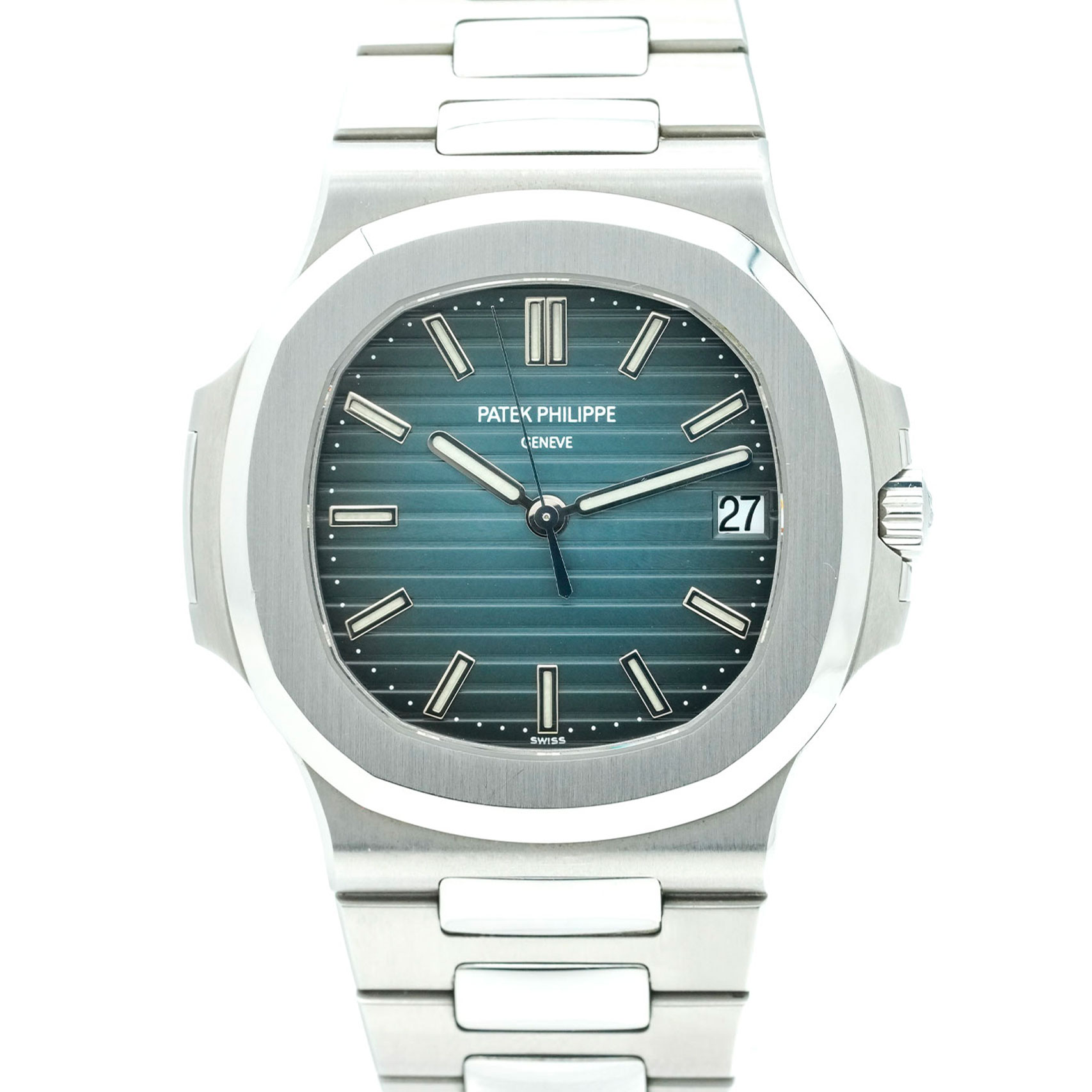
Nautilus
Model History
The Nautilus debuted at the 1976 Basel fair, designed by Gérald Genta — the same designer who four years earlier had created the Royal Oak for Audemars Piguet, paving the way for the concept of the luxury sports watch in steel. According to the story that has become legendary in watchmaking circles, Genta reportedly sketched the design in just five minutes while watching Patek Philippe's executives during a dinner at a hotel: the idea was born from the portholes of ocean liners, echoed both by the octagonal bezel case with chamfered corners and by the two lateral "ears" that fix it to the bracelet, designed like the watertight hinges of a deck hatch. The name, "Nautilus", is an explicit tribute to the famous submarine imagined by Jules Verne in his 1870 novel "Twenty Thousand Leagues Under the Sea".
The first reference, the 3700/1A, went into production in 1976 with a 42 mm steel case — enormous by the standards of the time, enough to earn it the nickname "Jumbo" — but with a thickness of just 7.6 mm, made possible by the extremely thin automatic caliber 28-255 C derived from a Jaeger-LeCoultre base. The dial featured the characteristic horizontal embossed stripes, which later became a distinctive trait of the line. It was a bold gamble for a brand that until then had built its image almost exclusively on gold dress watches: in 1976 the 3700/1A cost about 15,000 Swiss francs, more than an equivalent gold model, precisely because its production in steel, a material then considered "poor" for high watchmaking, required far more complex and costly machining.
In the following decades the line expanded while staying faithful to its original design: the ref. 3800, more compact (37.5 mm), broadened its audience to include female clientele from the early 1980s onward; the ref. 5711, presented in 2006 for the thirtieth anniversary, became in the 2000s and 2010s the most desired — and hardest to buy — object in all of contemporary high watchmaking, until Patek Philippe's sensational decision to discontinue it in January 2021. In its place, that same year, came the ref. 5811, which retains its general design with a redesigned case and slightly different proportions. In the meantime the Nautilus family has grown with more complicated executions — the 5712 with power reserve and moon phases, the 5990 with chronograph and travel time, the 5726 with annual calendar and chronograph — which today coexist with the base model as the collection's technical pinnacles.
Technical Specifications
Main References
In January 2021 Patek Philippe surprised everyone by announcing the discontinuation of ref. 5711/1A, at the time the most desired watch in the world: far from signaling a decline, the news triggered a speculative wave on the secondary market that multiplied its resale price well beyond the official list price, a phenomenon repeatedly cited as a case study in the economics of contemporary luxury.