

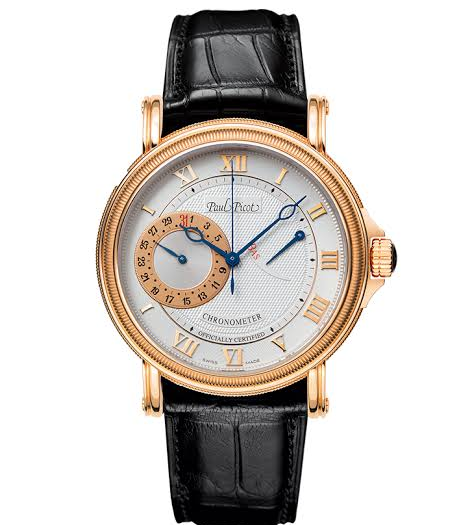
Atelier
Model History
The Atelier is the collection with which Paul Picot has historically measured its highest ambitions in terms of complication and finishing, setting itself apart from more commercial lines such as the Firshire or the Gentleman with a catalogue that ranges from relatively simple executions — three hands with a half-moon date at six o'clock — up to high-level complications such as the tourbillon. The round 42 mm case with a fluted side is the distinctive element that accompanies every execution in the line, a stylistic trait the brand has kept constant over time as a recognizable signature of the Atelier compared with the rest of the catalogue.
Among the line's best-known executions is the PP1100 version with a regulator layout, with separate displays of hours, minutes and seconds and a power-reserve indication, as well as a skeletonized "Open Face" variant that reveals the movement's architecture. At the top of the range sits the Tourbillon, offered in rose gold or white gold with a retrograde date: an execution that, according to the trade sources consulted, represents one of the rare cases in which a manufacture of Paul Picot's modest size offers in its catalogue a complication traditionally reserved for the great houses of high watchmaking.
Over the years the line has been restyled more than once — a significant renewal dates back to 2007 — and has continued to appear in new executions even in more recent years, confirming itself as the showcase for the brand's most ambitious complications even when the rest of its communication focuses on lines more oriented toward sales volume, such as the Yachtman Club. Independent sources dedicated specifically to the Atelier remain, however, more limited than those available for lines such as the Yachtman Club or the Firshire, and some details on the most recent executions should be verified directly on the brand's official channels.
Technical Specifications
Main Executions
The Atelier case's fluted side — a vertical-ribbed finish normally associated with the great houses of high watchmaking — has remained the line's most constant element of stylistic continuity, recognizable even as the complications housed under the dial change radically, from the simplest version up to the tourbillon.