

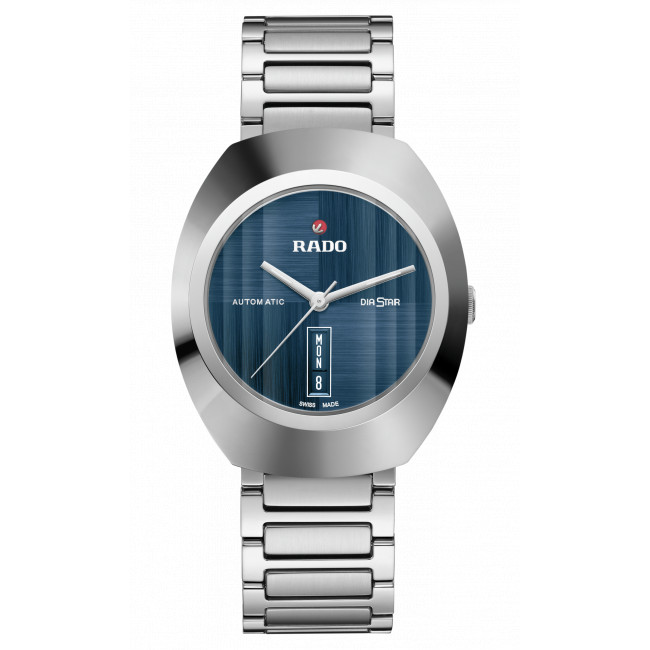
DiaStar
Model History
The DiaStar debuted in 1962 as Rado's answer to a very concrete problem in watchmaking at the time: how easily steel cases would scratch in everyday use. The brand's solution was radical: make the case out of tungsten carbide, an extremely hard ceramic-metal material, so resistant that it required diamond-tipped tools to be worked. Rado presented it to the public as the world's first scratchproof watch, a claim that became the starting point for the motto "Master of Materials" still associated with the brand today.
Beyond the material, the DiaStar also stands out for an immediately recognizable silhouette: a barrel-shaped case, a dodecagonal bezel, and a domed, faceted sapphire crystal, elements that over time became as much a part of the line's identity as the case's resistance. The model went through the following decades in numerous variants, accompanying Rado's expansion into other high-tech materials, from ceramic to Ceramos.
The most recent reissues, gathered under the name DiaStar Original, faithfully reproduce the historical aesthetic in more compact diameters, with automatic, quartz and even skeletonized versions that reveal the movement, often paired with colored PVD inserts that update in a contemporary key a design that has remained substantially faithful to the one from 1962.
Technical Specifications
Main Executions
The hardness of tungsten carbide, which makes the DiaStar's case practically impossible to scratch in everyday use, is the same characteristic that in the 1960s forced Rado's watchmakers to resort to diamond-tipped tools to cut and work it — a production problem that the brand turned into its main selling point.