

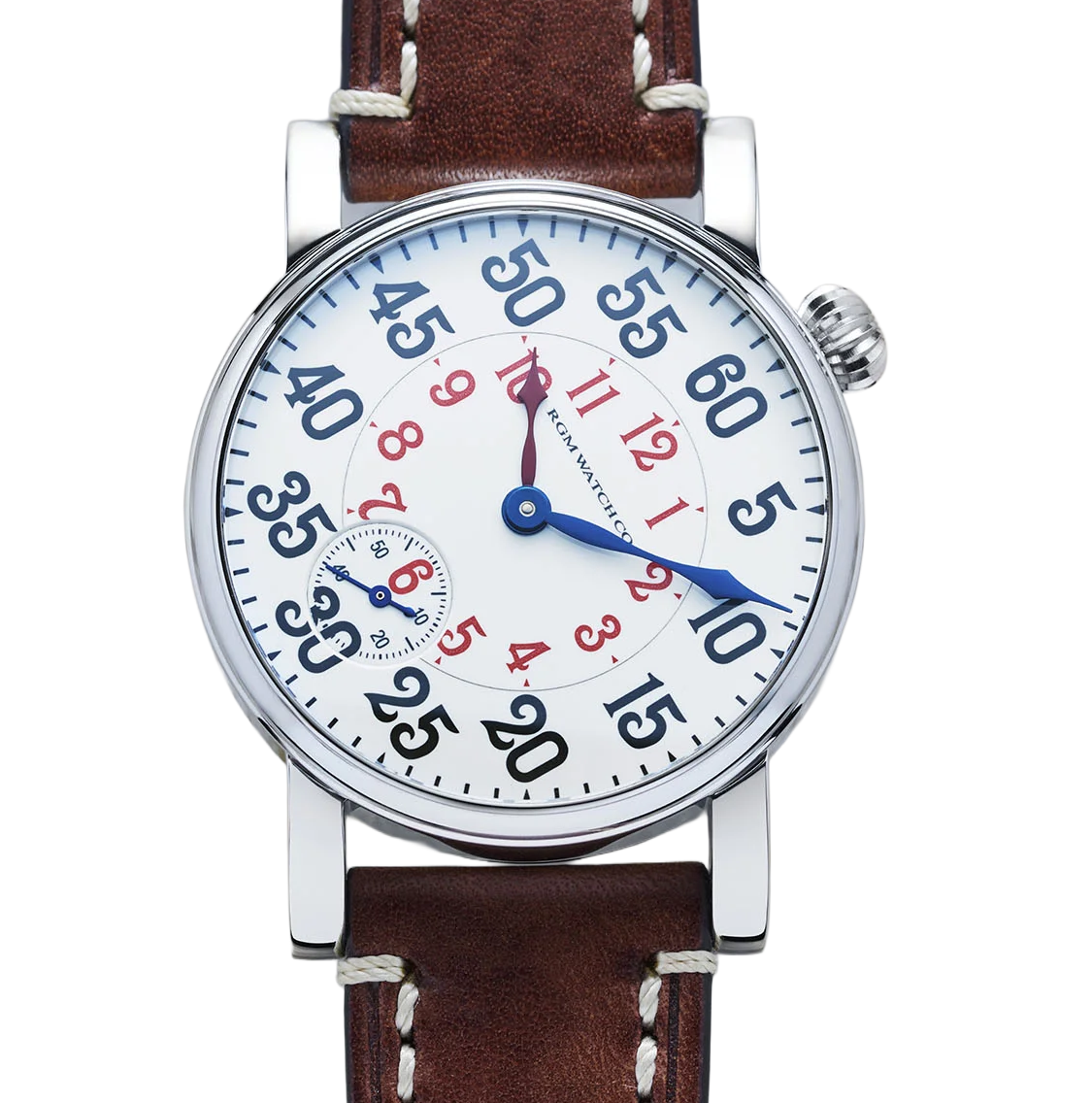
Line History
The Model 222-RR debuts in 2017, on the occasion of RGM's 25th anniversary, as a direct tribute to the American railroad watches that for decades had marked the punctuality of United States rail lines. The "RR" designation explicitly stands for "railroad"; the meaning of the number "222" is not documented in a verifiable way in the sources consulted, and is therefore reported here only as part of the model's commercial name.
Unlike the Pennsylvania Series, which is born from a newly conceived RGM caliber, the Model 222-RR uses authentic Hamilton pocket-watch movements of caliber 10 (grade 921 with 21 jewels, or the rarer grade 923 with 23 jewels, produced in fewer than 4,000 examples), fully reconditioned with a new mainspring and hand-finished components. The crown position at 1:30 is not a stylistic affectation, but faithfully reproduces the pocket-to-wrist conversions carried out between 1900 and 1920, when some pocket movements were adapted to the new format while keeping the seconds counter in line with 12 o'clock; for the same reason a left-handed version with the crown at 10:30 also exists.
The dial is the line's true narrative heart: RGM offers several Grand Feu enamel reinterpretations of it, each inspired by a historic standard of American railroad watchmaking. The most celebrated are the Ferguson, from a design patented in 1908 and produced by the O'Hara Dial Company of Waltham, Massachusetts; the Montgomery, developed by railroad inspector Henry S. Montgomery for the Atchison, Topeka and Santa Fe Railway (with Type I and the rarer Type II variants, patented in 1920); and the Boxcar, introduced in 1925 by the Ball Watch Company with thick, sans-serif numerals for maximum legibility.
Technical Specifications
Main Executions
Every Hamilton pocket movement fitted to the 222-RR is rebuilt by RGM with a new mainspring and steel components hand-repolished on a tin stake, using finishing techniques that are now rare even in contemporary fine watchmaking.