

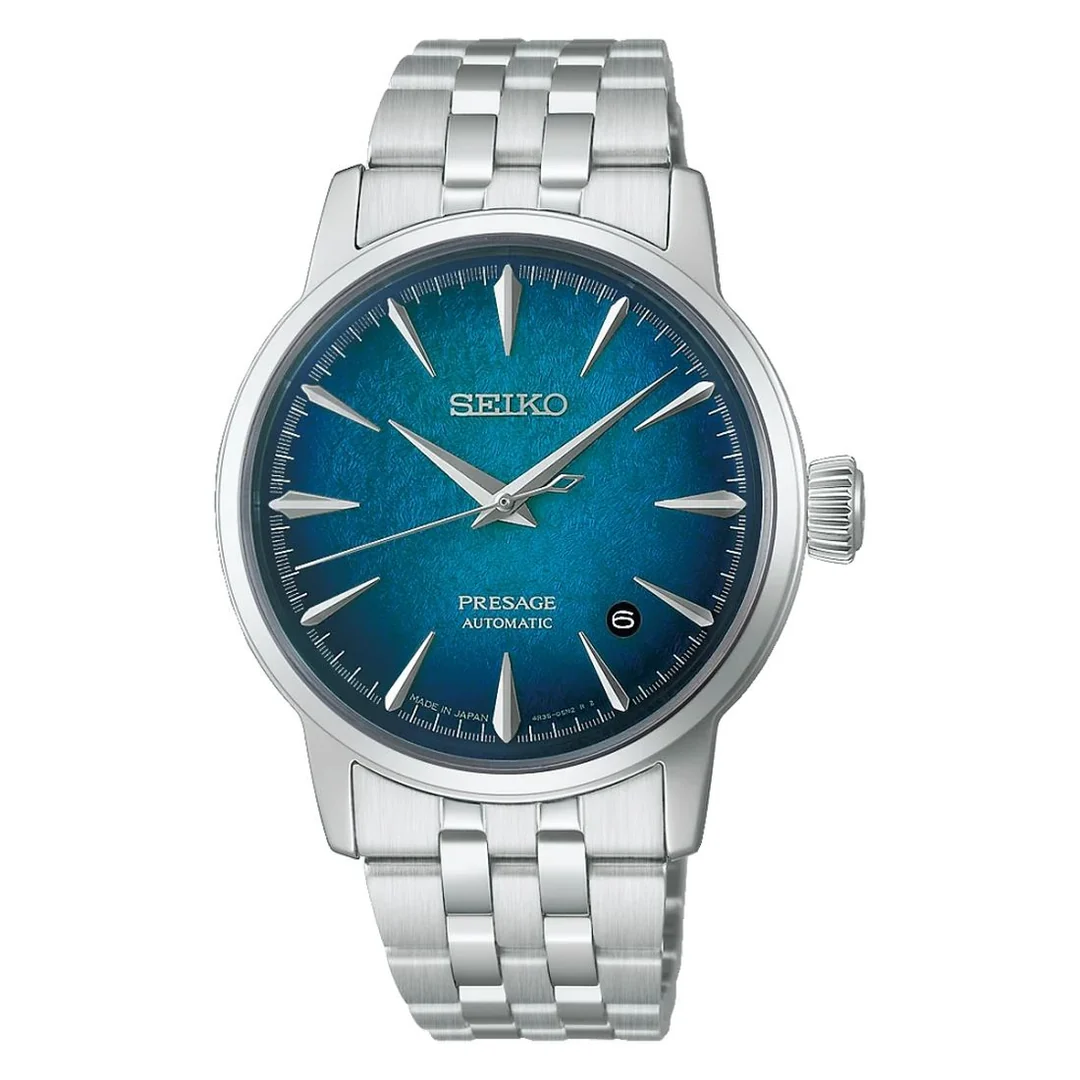
Line History
Presage is born as Seiko's answer to a need long left uncovered in its international catalogue: that of an elegant mechanical watch, accessibly priced but with authentically Japanese aesthetic care, distinct both from Prospex's sporty-professional register and from Credor's more exclusive high-end positioning. Initially distributed mainly on the Japanese domestic market, the collection arrives in organized form on international markets in 2016, presenting itself from the start as a declared tribute to the 1913 Laurel, the very first wristwatch produced in Japan, and more generally to over a century of Seiko manufacturing.
Presage's distinctive trait is the variety of decorative techniques applied to the dials, often derived from ancient Japanese artisanal arts. The Craftsmanship Series sub-line gathers the most elaborate executions: enamel dials made by hand by artisan Mitsuru Yokosawa, Arita porcelain dials, the typical white-and-blue ceramic of the town of the same name in Kyushu, Shippo cloisonné enamel dials, and Urushi lacquer dials, a technique entrusted to master Isshu Tamura — a process that requires multiple coats of lacquer and weeks of drying for each individual piece.
Alongside the more artisanal component, the Cocktail Time sub-line approaches elegance from a different angle: born from a collaboration with the celebrated Japanese bartender Shinobu Ishigaki, it offers sunburst dials and iridescent surfaces designed to recall the play of light in a well-made cocktail, often named directly after the world of mixology, such as Martini or Negroni. It is the more pop and accessible side of Presage, the one that has contributed most to the line's international popularity.
From a mechanical standpoint, Presage relies mainly on Seiko's own automatic calibers: the 4R35, with 41 hours of power reserve, for the simpler executions, and the more modern 6R35, with 70 hours of autonomy, for the higher-end versions. No declared claim to high watchmaking, but an explicit positioning as a gateway to Japanese in-house mechanics, at a price noticeably more contained than Grand Seiko or Credor.
Technical Specifications (base execution)
Main Sub-Lines
The Urushi technique used by Presage is the same traditional Japanese lacquering used for centuries on furniture, boxes and art objects: applying multiple layers of natural resin to a dial just a few centimeters across requires weeks of work and drying, a production time far removed from the industrial pace that characterizes the rest of Seiko's more accessible catalogue.