

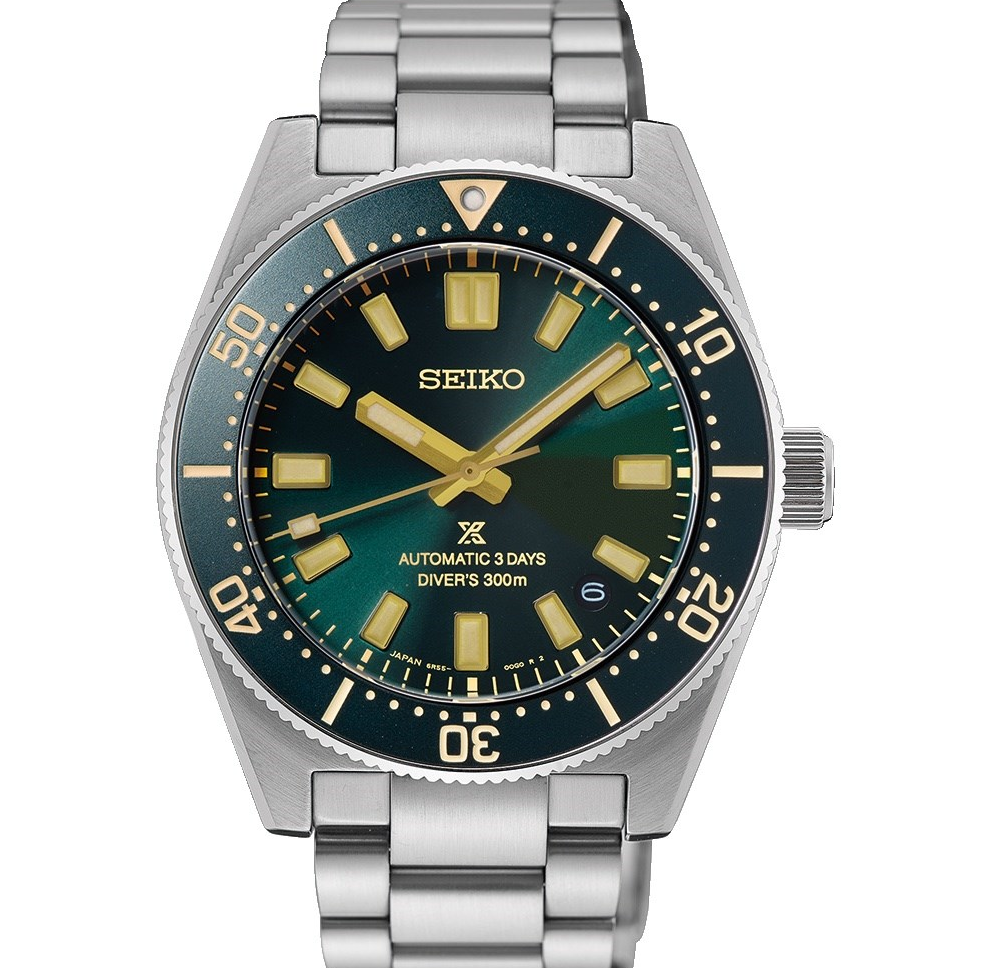
Prospex
Line History
The forerunner of the family that today bears the name Prospex is the 62MAS, presented in 1965 with reference 6217-8000: the first professional dive watch made by Seiko, arriving a few years behind its Swiss competitors but immediately able to establish a visual language destined to endure. A steel case of 37.7 mm, automatic caliber 6217, 150 meters of water resistance and a crown positioned at 3 o'clock — a choice later abandoned in subsequent models — make the 62MAS an object designed for real underwater use, not for wrist elegance: a layout that would influence Seiko's dive watches for decades to come.
In 1968 a decisive technical leap arrives: the Professional Diver's 300m, known among collectors by references 6159-7000 and 6159-7001, introduces a high-frequency automatic movement ("Hi-Beat", 36,000 vibrations/hour) and brings water resistance to 300 meters, with a more massive 44 mm case designed for professional saturation diving use. The next step comes in 1975 with the famous "Tuna" (ref. 6159-7010): an armored titanium case, protected by a ceramic shroud wrapping the crystal and crown, capable of withstanding the most extreme conditions of professional diving and become one of the most recognizable silhouettes in all of Japanese watchmaking.
The name "Prospex", a contraction of "Professional Specifications", is born to sum up in a single word the philosophy of these instruments — watches designed together with the people who actually use them, from divers to mountaineers — and consolidates in the following decades as the collection umbrella dedicated to all of Seiko's most hardcore wrist instruments; the brand's public sources do not report a single date on which the name became an official collection in its own right, but the technical continuity with the first divers of the 1960s is claimed by Seiko itself. Alongside the marine component, from 1959 there is also the land-based Alpinist, designed for high mountains with a built-in compass, and more recently the one linked to competition chronographs and high-altitude instruments.
Today Prospex gathers under a single graphic and commercial identity instruments for sea, land and sky: from mechanical divers that directly recall the 62MAS, Hi-Beat and Tuna, to quartz and hybrid versions born for continuous professional use, to limited-edition reissues celebrating the anniversaries of the original models — a catalogue that remains, in the brand's own stated intentions, still tied to the idea of real technical specification rather than simple sporty style.
Technical Specifications (62MAS, 1965)
Main Line Milestones
The nickname "Tuna" given to the 1975 Professional Diver's is not an invention of Western collectors but originated in Japan: the rounded shape of the ceramic-shrouded case, seen from above, actually resembles a can of tinned tuna — a comparison as informal as it is enduring, which still identifies the entire family of armored Seiko cases today.