

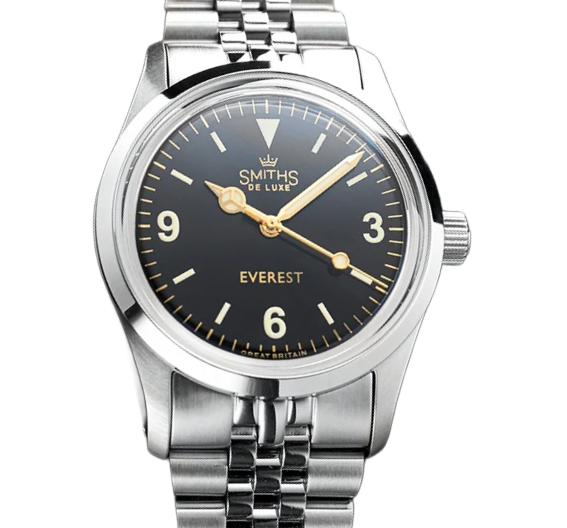
Everest
Line History
On 29 May 1953 Edmund Hillary and Tenzing Norgay are the first to reach the summit of Everest as part of the British expedition led by John Hunt. The episode has become legendary in watchmaking too, because on the climbers' wrists, according to the tradition handed down by enthusiasts, there would have been not only a Rolex Explorer but also a Smiths watch, official supplier of instrumentation for several British expeditions of the era. It is a widespread and often cited story, but it is treated by the sources with the same caution with which it must be said that Rolex's link to that day is, by contrast, extensively documented: the Smiths component of the story remains more anecdotal than proven in detail.
When, in the 2000s, Timefactors, the company of Eddie Platts that in the meantime had acquired the rights to the Smiths name, decides to build a line that would tell this heritage, the Everest collection is born, marketed under the internal code PRS-25. Rather than attempting a literal copy of a 1953 watch — for which no photographic or technical documentation exists comparable to that of the Rolex models of the time — the design of the Everest takes up the by-now classic language of exploration dials: triangle at 12 o'clock, Arabic numerals at 3-6-9 and rectangular indices in the other positions, on a black or white background legible in any lighting condition.
Over the years the Everest has been revised several times by Timefactors, moving from showier cases to more contained diameters and from Miyota movements of different generations (9015, then 9039), while keeping the same approach of a sturdy, no-frills exploration watch: a tribute declared to be more to the spirit of the 1953 expedition than to any one specific historic watch.
Technical Specifications
Main Executions
Unlike Rolex, which built around the 1953 expedition one of the most celebrated marketing narratives in watchmaking, Smiths for decades did not capitalize in any way on its alleged role on that day: only with the relaunch of the brand by Timefactors has this story been recovered and placed at the center of a product line.