

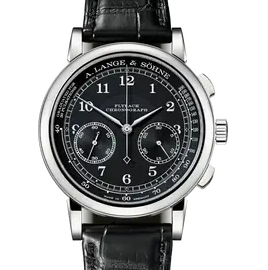
Model History
The name 1815 doesn't refer to the collection's launch year, but to a far more significant date: 18 February 1815, the birthday of Ferdinand Adolph Lange, who would go on to found the manufacture in Glashütte thirty years later, in 1845. The line debuted in 1995, a year after the Lange 1 and the Saxonia, inheriting the aesthetic language introduced by the 1994 Tourbillon "Pour le Mérite": a solid silver dial, printed Arabic numerals, a railway-track minute scale and heat-blued steel hands — a look that directly recalls the founder's 19th-century pocket watches.
If the Lange 1 represents the brand's innovation and the Saxonia its pure minimalism, the 1815 embodies its most historical, purist soul: a sapphire case back revealing the unplated German-silver three-quarter plate, the hand-finished screwed balance and the heat-blued screws. Over time the collection has expanded from simple three-hand versions to high-level complications — Up/Down with power reserve display, annual calendar, chronograph, tourbillon and the extremely rare Rattrapante Perpetual Calendar executions — eventually including the Grand Complication, the most complex timepiece the manufacture has ever built.
It's precisely this range — from entry models to the catalogue's most extreme complications — that has led industry critics to often describe the 1815 as the collection that best demonstrates the technical depth of Lange's calibres, making it one of the central lines of the brand's identity even today.
Technical Specifications
Key References Over Time
Among the family's most extreme executions is the 1815 Rattrapante Perpetual Calendar, while the very top of the collection is the Grand Complication: the most complex timepiece A. Lange & Söhne has ever produced, made in only a handful of examples and regarded by industry sources as one of the finest expressions of contemporary Saxon haute horlogerie.