

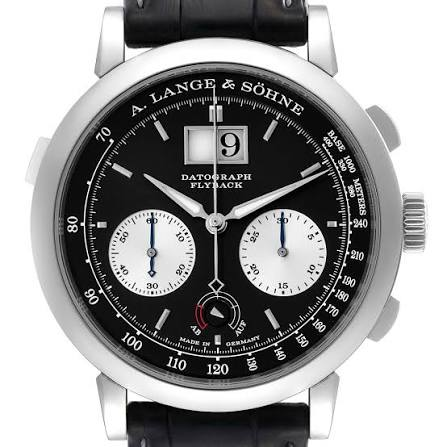
Model History
Conceived as early as the mid-1990s and presented in 1999, the Datograph arrived at a time when almost no manufacture still built its own chronograph calibre entirely in-house: most of the industry relied on third-party bases. A. Lange & Söhne instead chose to build from scratch a hand-wound chronograph movement with an outsize date and flyback function — no small undertaking just five years after the brand's relaunch.
The result, calibre L951.1, has become one of the most cited references in modern mechanical watchmaking: independent watchmaker Philippe Dufour reportedly called it, according to several trade sources, "the finest chronograph movement ever made." The combination of traditional Saxon finishing — an unplated German-silver three-quarter plate, a hand-finished balance cock, heat-blued screws — with a chronograph architecture of rare cleanliness (counters at 4 and 8 o'clock, a column wheel visible through the case back) made the Datograph a benchmark both technically and aesthetically.
Over the years the family expanded with the Datograph Perpetual variant (perpetual calendar), the 2012 Datograph Up/Down with an enlarged case and power reserve indicator, and two world firsts built on the same architecture: the Double Split (2004), the world's first chronograph with a double rattrapante — able to measure split times on both minutes and seconds — and the Triple Split (2018), which adds the rattrapante function to hours as well.
Technical Specifications
Key References Over Time
The number of Datograph pieces produced across all metals since 1999 remains relatively low compared with other high-end chronographs — a scarcity that, combined with calibre L951.1's technical reputation, makes it one of the most sought-after watches among collectors on the secondary market, often described by trade sources as "grail watch territory."