

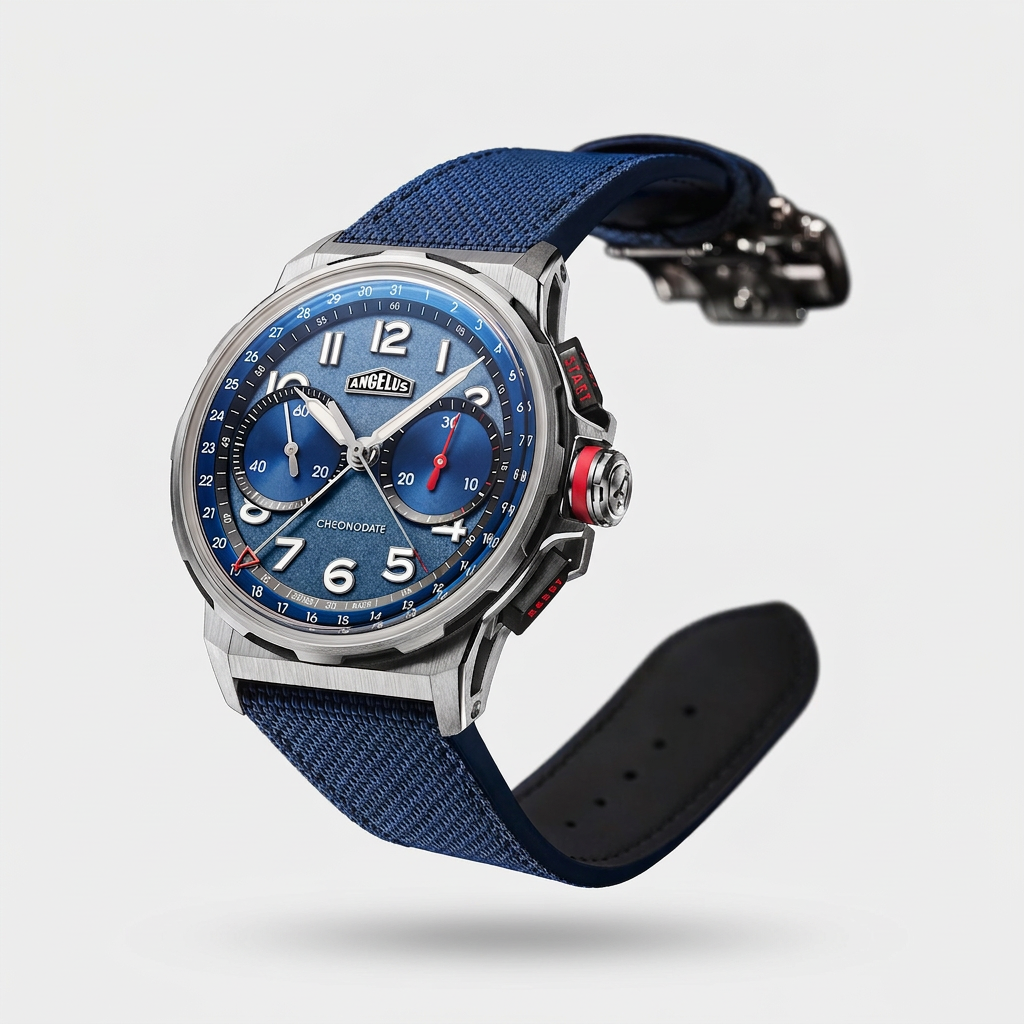
Model History
Launched in 1942 as the "Chronodato," the watch combined a bicompax chronograph with a pointer-hand date indication — a configuration unheard of at the time, which earned it the reputation of being the world's first serially produced chronograph with an integrated calendar. The model quickly became the most celebrated and representative of the entire Angelus output.
In 2022, to mark the 80th anniversary of the original, the relaunched brand presented a contemporary reinterpretation: not a faithful reissue but a modern evolution, with an angular six-component case and a carbon-composite sub-case, available in titanium or 18-carat red gold. The date hand, with its red triangular tip, directly recalls the original 1942 design.
The A500 calibre, made by La Joux-Perret and based on the Valjoux 7750 architecture, modernizes the chronograph's mechanical heart while keeping intact the spirit of the bicompax-with-date configuration that had made the Chronodato famous eighty years earlier.
Technical Specifications
Main Executions
The red triangular-tipped date hand on the 2022 version is not a simple aesthetic detail: it faithfully reproduces the pointer-hand design used on the 1942 original, a way of visually linking the two generations of the model eighty years apart.