

Model History
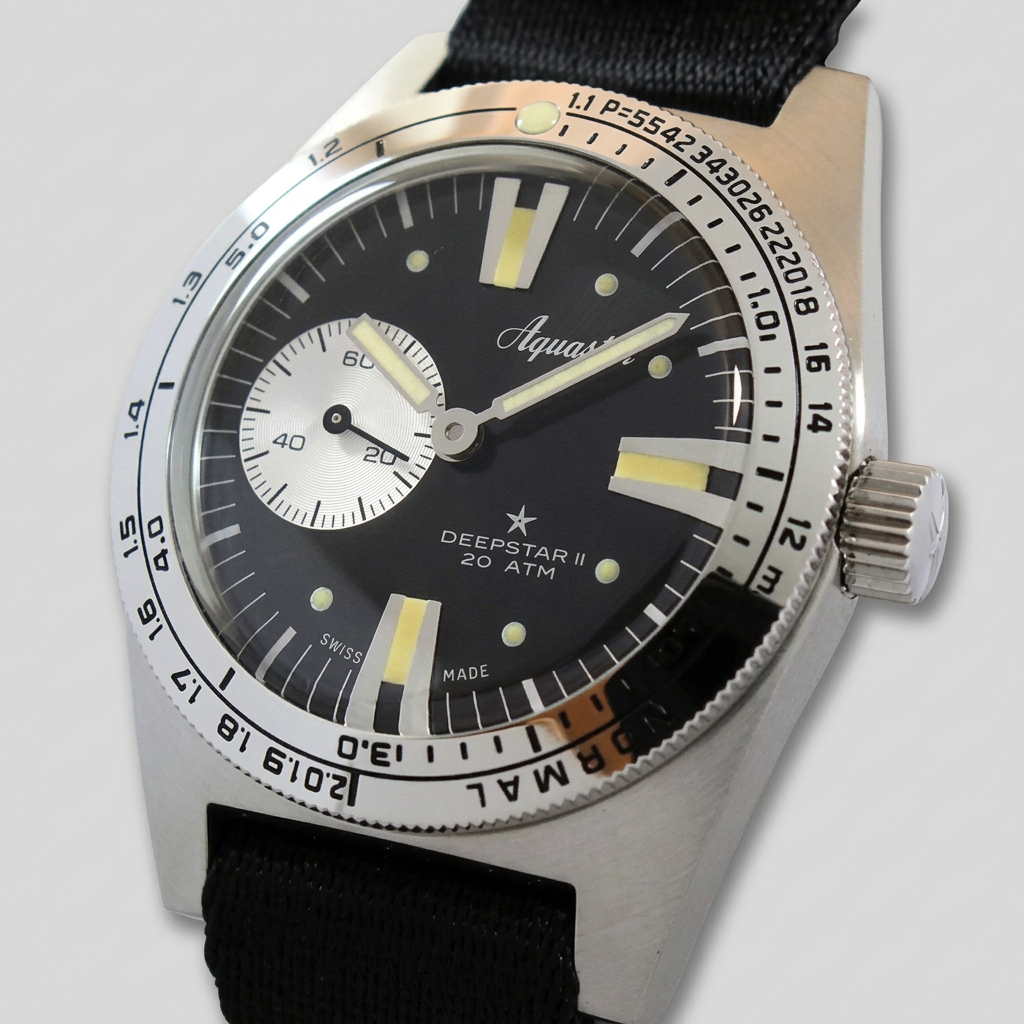
The Deepstar debuted in 1962, the same year Aquastar was founded, designed by Frédéric Robert on commission from the French Marine Nationale. It wasn't conceived as a simple dive chronograph but as a genuine dive-planning instrument: its main innovation is the no-decompression bezel, patented in 1964 (Swiss patent CH 436 140), which combines on a single calibrated scale both elapsed dive time (60 minutes) and the no-decompression limits according to the French Navy's tables of the time.
Thanks to this bezel, a diver could plan repeated dives directly from the wrist, without needing to consult external tables — a huge operational advantage for military or professional use. The original piece housed a Valjoux 23 column-wheel chronograph calibre, prized for the crisper, more precise pusher engagement it offered compared with the cam-actuated mechanisms of the era.
Modern versions, relaunched after mechanical production resumed in 2020, house a manually wound column-wheel calibre developed by La Joux-Perret specifically for Aquastar — described by the brand itself as the closest possible mechanical equivalent to the original 1962 Valjoux 23 — while keeping compact dimensions (37 mm for the Deepstar II, 39 mm for the chronograph variants) and 200 metres of water resistance.
Technical Specifications
Main Executions
The Deepstar's bezel doesn't just calculate elapsed time: by cross-referencing the minute scale with the no-decompression scale, it let a military diver read directly from the wrist how much longer they could stay submerged before having to observe decompression stops — a true mechanical dive computer, decades before electronic dive computers existed.