

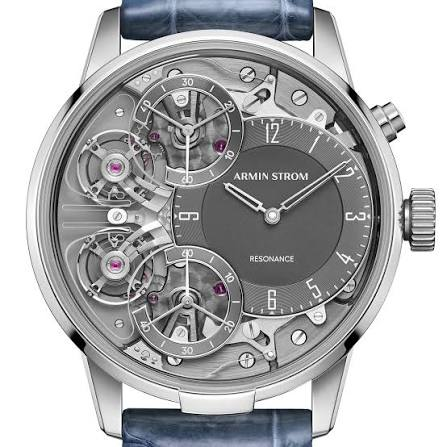
Mirrored Force Resonance
Model History
Unveiled in 2016, the Mirrored Force Resonance is modern Armin Strom's most identifiable invention: the first wristwatch to make visible and adjustable, via a patented elastic bridge, the physical phenomenon of resonance discovered by Dutch scientist Christiaan Huygens in the 17th century, when he observed two pendulum clocks placed near each other gradually synchronizing their oscillations in opposite directions.
The hand-wound ARF21 calibre houses two fully independent balance wheels — each with its own going train, its own barrel and its own escapement — linked not by a gear but by a thin steel leaf spring that gently pushes them toward one another. Within minutes of being started, the two balances find a natural resonance on their own, oscillating in perfect phase opposition: a phenomenon that makes the overall regulator more stable and more shock-resistant than traditional resonance mechanisms, where the rigid mechanical link between the two regulators is more delicate.
Unlike traditional dual resonating balances, here the phenomenon isn't hidden beneath the plate but displayed prominently at the center of the dial, with the two slender mirrored bridges that give the watch its name, "Mirrored." The result, beyond its technical value, is also aesthetic and educational: the owner literally watches the physics of resonance happen before their eyes every time they check the time.
Technical Specifications
Main Executions
The phenomenon of resonance between pendulums was first observed by Christiaan Huygens in the 17th century, when he noticed that two pendulum clocks hung on the same wall always ended up oscillating in perfect phase opposition, whatever their starting offset: Armin Strom was the first manufacture to bring this principle, for centuries a laboratory curiosity, into a functioning wristwatch.