

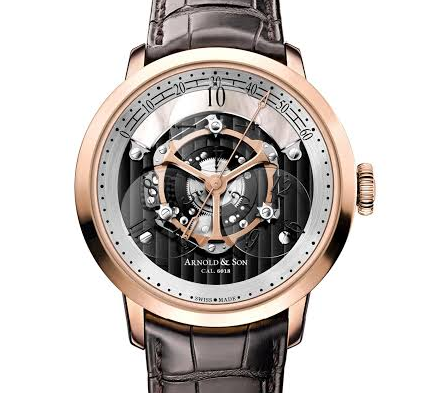
Golden Wheel
Model History
Presented in 2015 as part of the Instrument Collection, the Golden Wheel reinterprets a historic watchmaking mechanism — wandering hours, invented in the 17th century — replacing the traditional flat discs with an actual central carousel in solid 18-carat rose gold, which gives the watch its name. Three sapphire discs rotate simultaneously around a central axis and on their own individual axis, displaying the hour numerals in succession along the upper arc of the dial, where the minutes run along a graduated scale.
Alongside the "wandering" hour display sits a second chronometric complication dear to the brand's tradition: the "true beat" dead-seconds function, which advances the seconds hand with a sharp, once-a-second jump instead of the usual continuous sweep — a mechanical imitation of the ticking of old pendulum clocks, achieved with a dedicated mechanism built into the automatic calibre.
The 44 mm case in 18-carat rose gold, paired with a dial embellished with mother-of-pearl inserts along the hour arc, and the high-watchmaking finishing of the movement — hand-beveled bridges with polished edges, fine circular graining, radiating Côtes de Genève, circular-grained wheels and blued screws — place the Golden Wheel among the collection's most refined expressions, produced in a limited series of 125 pieces.
Technical Specifications
Main Executions
The Golden Wheel combines two chronometric complications from very different eras in the same watch: wandering hours, devised by Vatican watchmakers in the 17th century for table clocks with fixed dials, and the "true beat" dead-seconds function, originally conceived to make wristwatches look, at a glance, more like the pendulum marine chronometers of earlier centuries.