

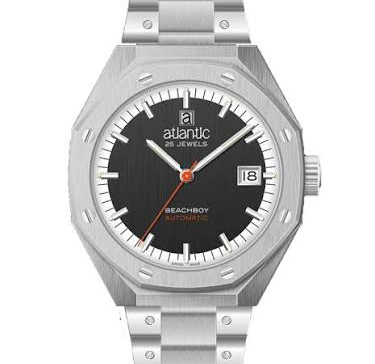
Model History
Launched in 1970, the Beachboy is arguably the longest-running and most recognizable model in the Atlantic catalogue: a sports watch with a rugged, straightforward character, designed for active everyday use, which carved out solid commercial success in the very years when the arrival of quartz was pushing much of traditional mechanical watchmaking into crisis — no small achievement for a model of its era, one that has kept it in the brand's catalogue to this day.
The name itself, "beach boy," evokes the model's casual, water-resistant spirit, in keeping with Atlantic's long tradition of building waterproof cases dating back to the 1930s. Over the decades the Beachboy has gone through several stylistic reworkings, but its most recent iteration presents itself explicitly as a retro revival, openly reclaiming "Atlantic's original 1970s look" for a contemporary audience.
The current version houses the proven Swiss automatic ETA 2824-2 calibre, set in a 40 mm steel case with a transparent screw-down case back that offers a glimpse of the movement — no small detail for a model in an accessible price segment — paired with a black dial with hand-applied indices and a steel bracelet with a butterfly clasp.
Technical Specifications
Main Executions
The Beachboy was born in the very years when Swiss mechanical watchmaking was going through its deepest crisis because of competition from quartz movements: staying in production, albeit through several reworkings, for more than half a century after a debut at such an unfavorable moment for mechanical watches is an achievement few contemporaries of its era can claim.