

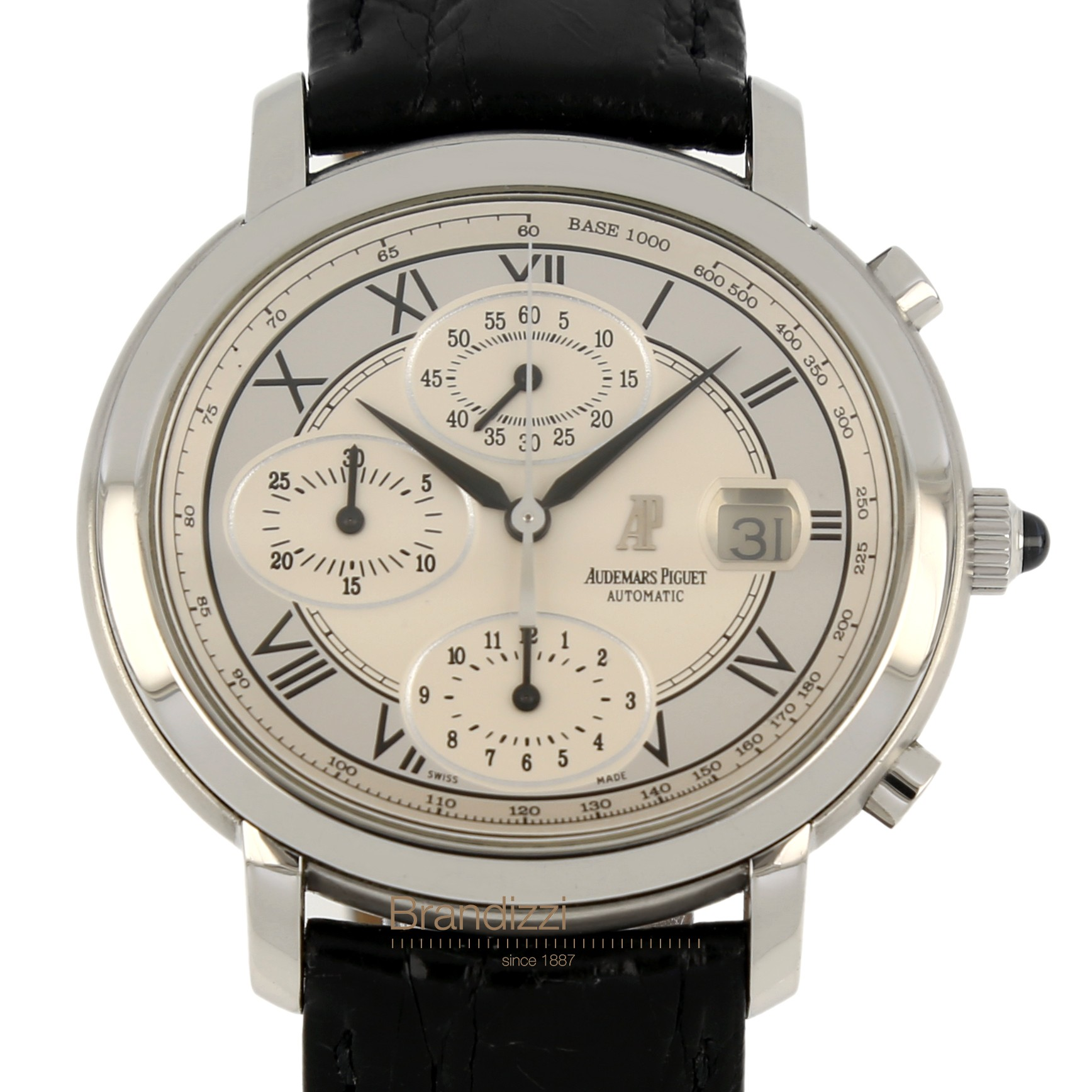
Millenary
Model History
Introduced in 1995, the Millenary was born as a collection parallel to the Royal Oak: an openly stated attempt to offer an aesthetic language alternative to the octagonal bezel that, even by then, had established itself as the brand's dominant image. The chosen shape, an oval/barrel-shaped case far removed from any classic watchmaking geometry, set out from the start to distinguish itself both from the Royal Oak and from the traditional round dress watches of the competition.
The collection's most recognizable feature is its off-center dial, shifted toward the edge of the case to leave the gears and regulating organs of the movement visible in the remaining space: a layout that, in its more elaborate executions, goes so far as to literally flip the calibre to expose components — such as the balance wheel and pallet fork — normally hidden on the back. The result is a watch that openly presents itself as a "showcase" for the manufacture, in a deliberate play of perspective and asymmetry.
While never reaching the mass popularity of the Royal Oak, the Millenary has carved out a loyal niche over the years among collectors who appreciate more conceptual watchmaking, less tied to sporty codes, also distinguishing itself with certain jewelry and artistic variants aimed at a female audience, a segment in which the brand has invested consistently.
Technical Specifications
Main Executions
In the Millenary 4101 version, the movement was literally flipped relative to its usual configuration, bringing into view on the dial components — such as the balance wheel and the escapement's pallet fork — that in traditional watches remain hidden beneath the case back: a choice that overturns the very idea of the "dial" as a simple surface for reading the time.