

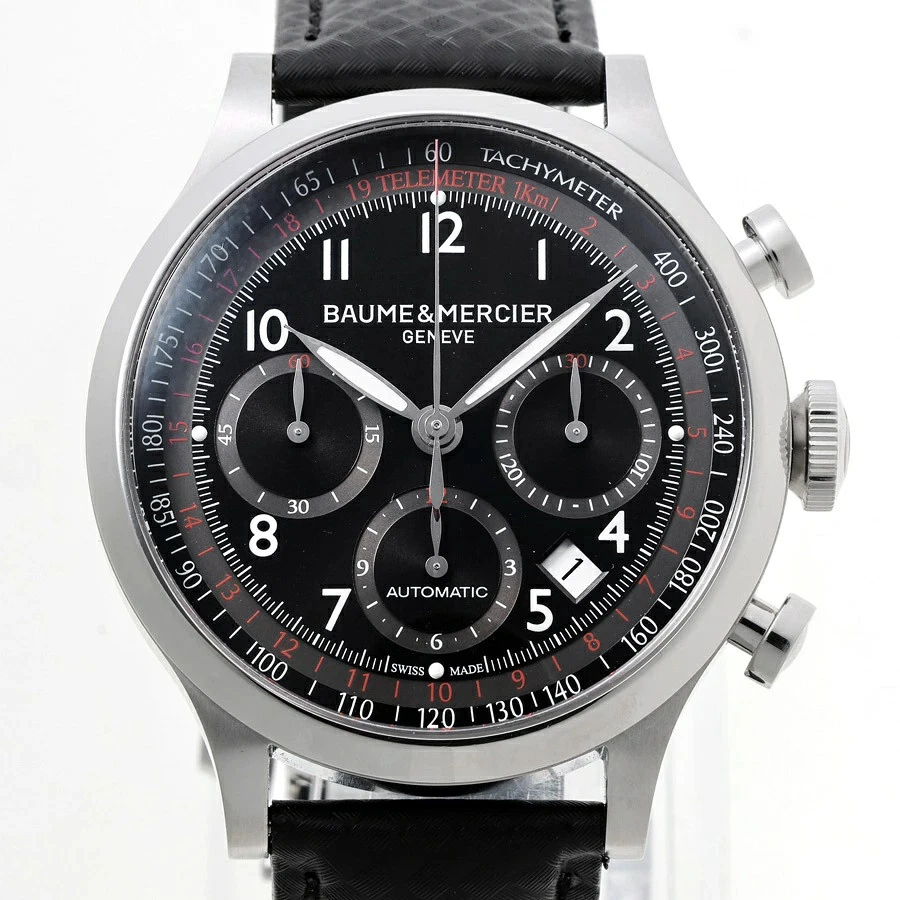
Capeland
Model History
The Capeland name was first used by Baume & Mercier for a series of chronographs made in the 1990s, but the aesthetic now associated with the model looks much further back in time: it freely draws on a chronograph produced by the maison in the late 1940s, borrowing its rounded "propeller" hands and softly drawn Arabic numerals, typical of postwar wristwatches.
The version that made the Capeland name recognizable among enthusiasts and collectors debuted at the SIHH in Geneva in 2011: a steel case with curved lugs, a tricompax dial with chronograph counters, a tachymeter scale and, on some executions, a red telemeter scale — a dense but balanced graphic layout, designed to faithfully convey the atmosphere of mid-twentieth-century wrist instruments without mimicking the now very crowded codes of aviation or motorsport watchmaking.
In 2016 the collection also featured a series of special editions dedicated to the Shelby Cobra, created in collaboration with the historic American car brand — one of Baume & Mercier's rare "themed" forays into the world of motorsport, shared in parallel with the Clifton as well. Although it remains a niche collection compared with big sellers like the Classima or the Clifton, the Capeland is considered by part of the trade press to be one of the most underrated chronographs in the mid-range Swiss landscape, precisely for its ability to offer a historically grounded design without the "cult" premium reserved for other, more celebrated names.
Technical Specifications
Main Executions
Unlike many collectible chronographs, which build much of their appeal on a declared link to aviation, motor racing or space exploration, the Capeland deliberately plays a different card: its narrative stays anchored to a historic in-house model from the late 1940s, without seeking sponsorships or anecdotes borrowed from other worlds — a positioning choice some trade observers have described, with a certain favor, as "understated."