

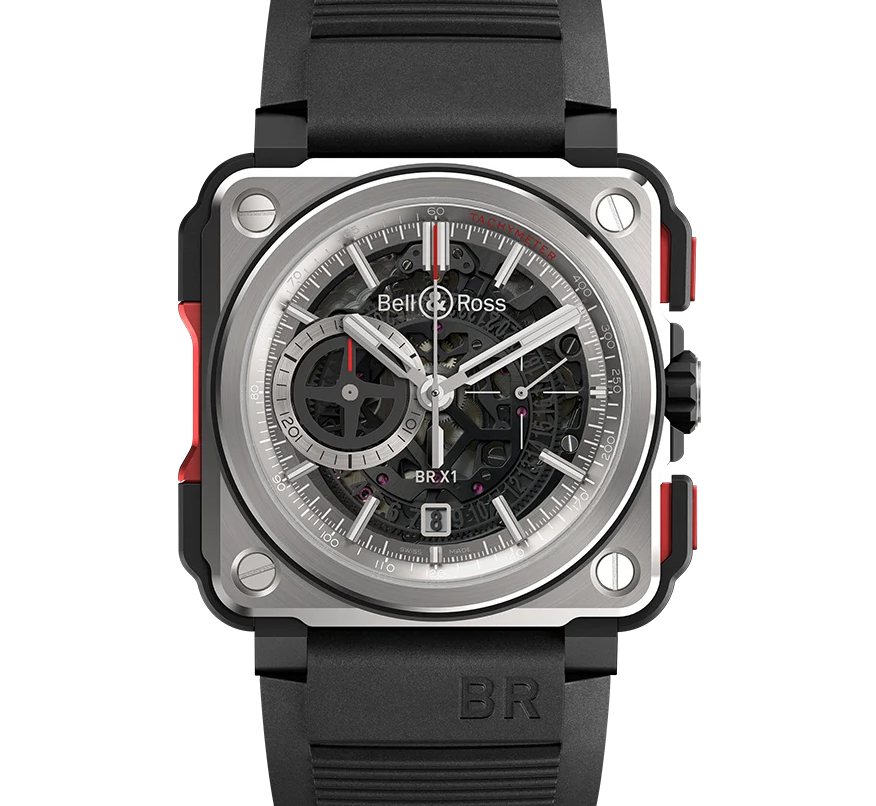
BR-X1
Model History
Presented in 2014, the BR-X1 was born as the brand's technical showcase: an "experimental" line designed to show how far Bell & Ross could push its "cockpit instrument" layout when the limit is no longer just aesthetic, but also mechanical and engineering-driven. The name itself is a declared tribute to the Bell X-1, the experimental rocket-powered aircraft that in 1947, piloted by Chuck Yeager, became the first aircraft in history to break the sound barrier — a reference the brand chose to make explicit right in the model's name.
The 45 mm case takes the classic Bell & Ross square layout and reinterprets it with a multi-level construction in grade 5 titanium, reinforced at the corners with ceramic and rubber inserts designed to absorb shocks, while the rocker-type chronograph pushers are likewise made of ceramic with rubber inserts for a more secure grip. The openly skeletonized dial reveals the entire architecture of the movement through a sapphire disc, with the classic "X" bridge — a direct nod to the model's name — clearly visible at the center.
Over the years the BR-X1 has been offered in numerous limited series with reduced production runs (generally between 100 and 500 pieces), often made in collaboration with military units or tied to specific aeronautical themes — from black titanium editions to the "Instrument de Marine" and "Hyperstellar" versions — confirming the BR-X1's role as the technical and aesthetic flagship of the Bell & Ross catalogue, distinct from more mainstream production lines such as the BR 01, BR 03 and BR 05.
Technical Specifications
Main Executions
The "X-1" name is not a simple internal code: it directly recalls the Bell X-1, the experimental rocket-powered aircraft with which Chuck Yeager first broke the sound barrier in 1947 — the same "experimental," technically pushed spirit that Bell & Ross wanted to carry over into the most technical and complex line of its watch catalogue.