

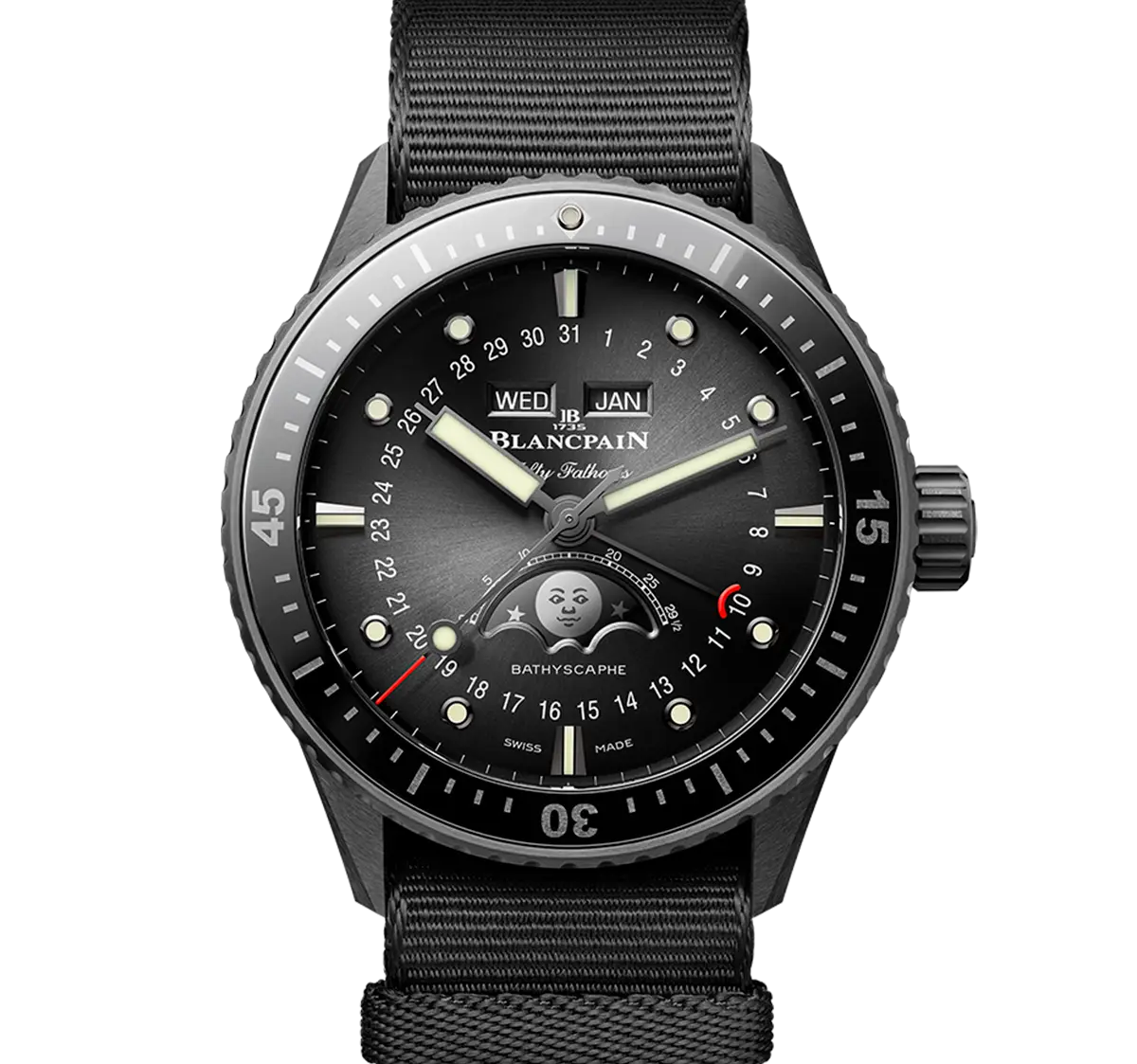
Bathyscaphe
Model History
The Bathyscaphe was born in 1956, just three years after the Fifty Fathoms, as a more compact, "civilian" interpretation of the same dive-watch concept. The name, far from a coincidence, pays tribute to the bathyscaphe Trieste with which physicist Auguste Piccard reached a record depth in January 1953: Jean-Jacques Fiechter, then leading Blancpain and already the creator of the Fifty Fathoms, registered its use for the new model just days after that feat, establishing from the outset a direct link between the watch and the exploration of the deep sea.
Compared with the Fifty Fathoms, designed for military combat swimmers, the Bathyscaphe was aimed at a broader audience of enthusiasts and sport divers, with a more compact case and more understated lines: it falls, together with other models of the era, into what watchmaking historians informally call the "skin diver" category, dive watches designed for recreational rather than professional use.
After a period of lower commercial visibility, Blancpain relaunched the Bathyscaphe as a standalone collection starting in 2013, within the broader Fifty Fathoms family, with ceramic cases, modern materials and a cleaned-up aesthetic that nonetheless retains its more discreet character and more accessible price positioning compared with its bigger sibling. In 2026, on the occasion of the model's seventieth anniversary, the brand presented a limited edition inspired by the 1968 version.
Technical Specifications
Main Executions
The name Bathyscaphe was not born as a marketing gimmick: it was chosen as a direct tribute to Auguste Piccard's bathyscaphe Trieste, protagonist of a record dive in January 1953. Jean-Jacques Fiechter, who would soon also tie his name to the Fifty Fathoms, decided to name the new model after that scientific feat just days later — a detail that shows how, since the 1950s, the exploration of the deep sea has been part of Blancpain's very identity.