

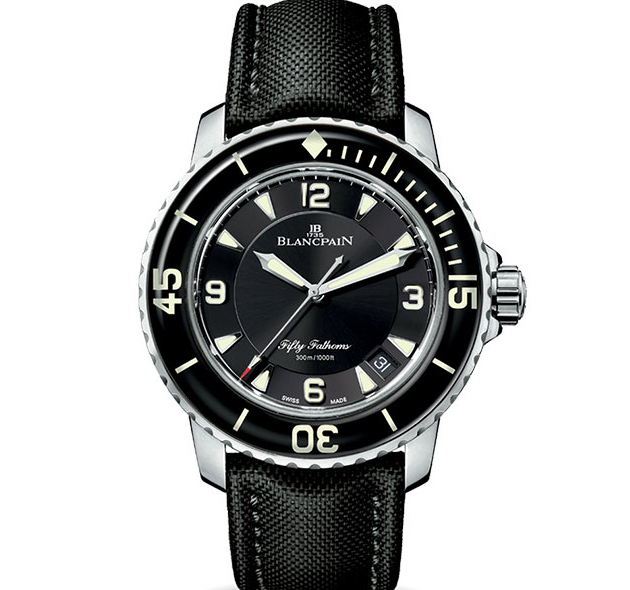
Fifty Fathoms
Model History
The Fifty Fathoms was born in 1953 from the meeting of two parallel needs: that of Jean-Jacques Fiechter, then CEO of Blancpain and a diving enthusiast, who after a personal experience at the edge of diving safety recognized the need for a reliable instrument to measure time underwater; and that of Captain Robert Maloubier, founder of the French Navy's combat swimmer unit, in search of a watch his men could actually use on missions. Their exchange gave rise to a watch conceived not as an accessory but as a professional instrument.
The features established from the very first example became, over time, the standard for the entire category: a graduated unidirectional rotating bezel for calculating dive times, a stated water resistance of at least fifty fathoms (the "fathom" unit gives the model its name, equal to about 91 meters), large, strongly luminescent indices and hands readable even in poor visibility, and an automatic movement to avoid crown manipulation underwater. For these reasons the Fifty Fathoms is generally recognized by watchmaking historians as the first true modern dive watch, adopted in the following years by several military units, including the United States Navy.
After decades of evolutions, reworkings and periods of lower commercial visibility, the collection was relaunched on a large scale by Blancpain starting in the 2000s, pairing versions more faithful to the original aesthetic with more modern, technical interpretations, such as the Automatique variant described here, made in red gold or titanium with an in-house triple-barrel movement.
Technical Specifications
Main Executions
A 1959 United States Navy test report, written after twelve Fifty Fathoms examples were used during Operation Hardtack, officially recommended its features as a reference for future military procurement: a rare acknowledgment for a civilian watch, testifying to how much the model was considered a genuine professional instrument.