

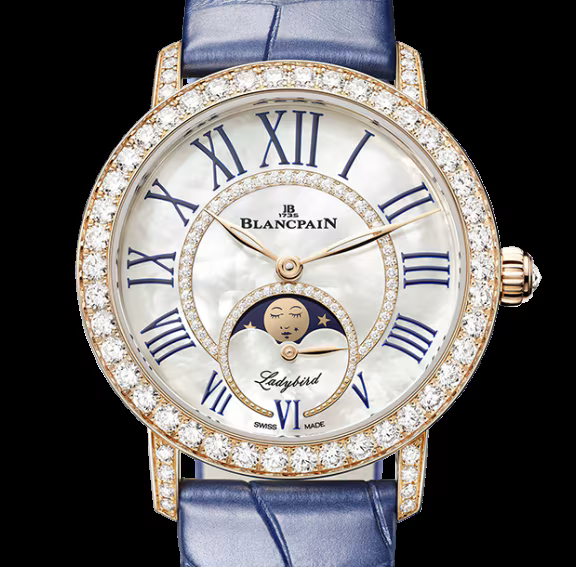
Ladybird
Model History
The Ladybird was born in 1956, at a time when high-end women's watchmaking was often treated as a simple piece of jewelry rather than a true mechanical instrument. Developed under the direction of Betty Fiechter — a pivotal figure in Blancpain's history, among the first women to lead a Swiss watchmaking manufacture — the model at the time housed what the brand presents as one of the smallest round mechanical movements ever made, enclosed in a case of remarkably compact dimensions for the standards of the era.
The choice of name, which in English refers to the ladybug, recalls both the small size and a certain decorative lightness, but behind its jewelry-like appearance lies a non-trivial technical effort: miniaturizing an entire automatic-winding movement without compromising its reliability requires specific construction solutions, very different from simply scaling down a men's calibre.
Over the decades the collection has been reinterpreted several times, up to the most recent generation presented on the occasion of the model's anniversaries — including the Lady B line, which revives the spherical, compact layout of the 1956 original while updating it with modern in-house calibres, silicon balance wheels and a range of dials and straps designed for a contemporary audience, while keeping the underlying idea intact: a small watch, but mechanically complete.
Technical Specifications
Main Executions
Blancpain presents the 1956 Ladybird as fitted with one of the smallest round mechanical movements ever produced up to that point: a record that, according to available sources, held for a long time before being surpassed by even more miniaturized calibres, and one the brand still recalls as one of the most significant technical moments of its twentieth-century history.