

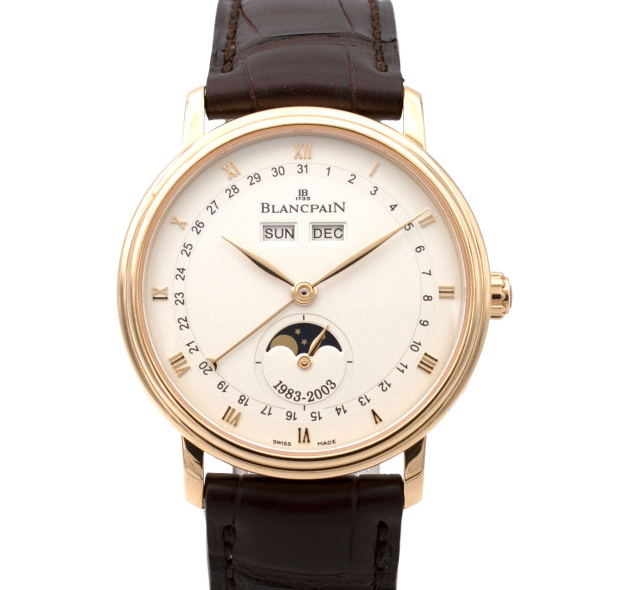
Villeret Quantième Complet
Model History
The Villeret collection takes its name from the village in the Swiss Jura where Jehan-Jacques Blancpain founded the manufacture in 1735, and it is the line through which the brand expresses its idea of classical watchmaking: round cases, sober dials, Roman numerals and traditional complications executed with refined finishing, in contrast to the more instrumental language of the Fifty Fathoms. Within this collection, the Quantième Complet holds a central place as the representative of the full calendar, one of high watchmaking's classic complications.
The full calendar (in French "quantième complet") displays hours, minutes, seconds, day of the week, month and moon phase, all read through distinct analog indications rather than digital windows: a choice that requires dedicated correctors, generally positioned under the bezel, to adjust each indication individually after months with fewer than thirty-one days. It is one of the complications most loved by collectors precisely for the compositional balance it demands among the different pieces of information on the dial.
Current versions of the Quantième Complet are produced in 18-carat red gold, with dials in shades such as deep blue finished with a sunray pattern, and house the in-house calibre 6654, an automatic movement entirely developed and produced by Blancpain, consistent with the brand's choice not to rely on external suppliers for its main complications.
Technical Specifications
Main Executions
Unlike most full calendars, which use digital windows for one or more indications, Blancpain's Quantième Complet shows every piece of information — day, date, month, moon phase — through distinct analog hands and indices: a stylistically more demanding choice to compose on a dial of just 40 mm, but consistent with the classical layout the Villeret collection claims from its very name.