

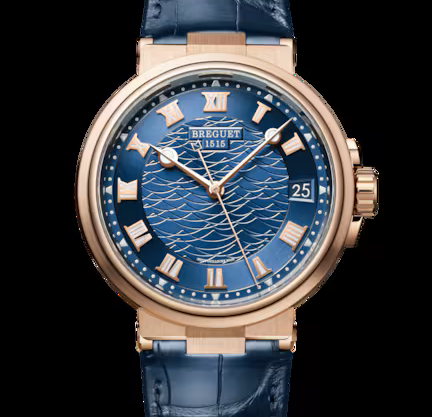
Marine
Model History
The roots of the Marine collection go back well before its birth as a wristwatch line: in 1815 Abraham-Louis Breguet received from Louis XVIII the appointment of "Horloger de la Marine," official watchmaker of the French Navy, a title that recognized the supply of extremely precise onboard chronometers — instruments with a double barrel and detent escapement, essential for calculating longitude during long crossings. This heritage remained for over a century and a half a chapter of naval history more than of wristwatch making, until, in 1990, the maison launched the first Marine collection for the wrist, an explicit bridge between the founder's marine chronometers and the contemporary sporty-elegant watch.
During the 2000s, and in particular with the 2005 restyling, the Marine took on a bolder, more recognizable aesthetic: sturdier cases, fluted bezels, guilloché dials with applied indices and a distinctly "sporty" language compared with the more formal register of the Classique. Over time, the simple three-hand version was joined by executions with progressively more elaborate complications, from the chronograph to multiple time zones.
The most recent generations — led by the 5517 with the automatic calibre 777A — confirm the Marine as the most contemporary "everyday" line in the Breguet catalogue: a rubber strap with a deployant buckle, a screw-down crown, water resistance up to 100 meters, and at the same time high-watchmaking complications such as the running equation of time or the ultra-thin tourbillon in the more precious versions, proof that the collection's "sporty" soul never gives up the technical level that defines the manufacture.
Technical Specifications
Main Executions
The title "Horloger de la Marine" was not a simple honorary tribute: the chronometers Breguet made for the French fleet had to guarantee a precision that would allow longitude to be calculated on the open sea, one of the most sought-after technical challenges of the era. The wristwatch collection born in 1990 still carries the name of that appointment received over two centuries earlier.