

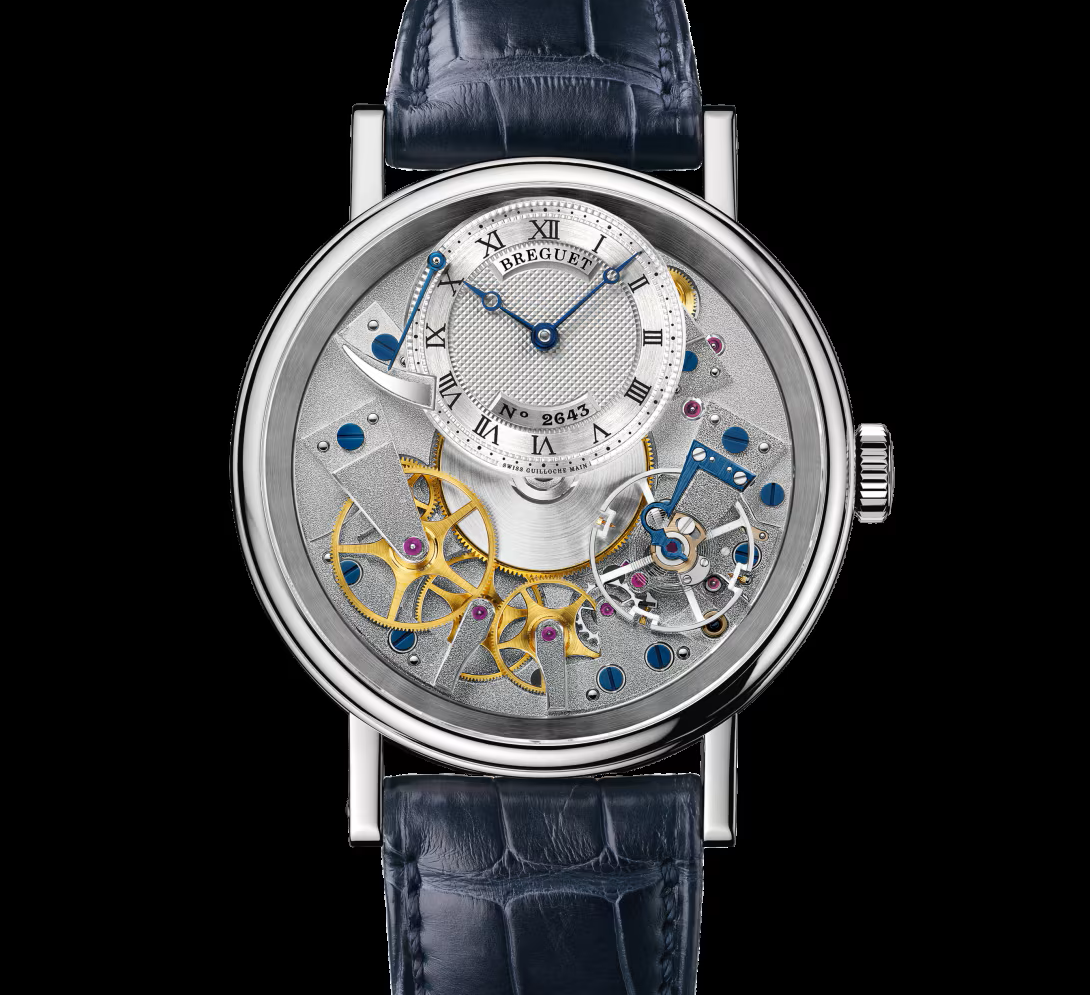
Tradition
Model History
The Tradition collection debuted in 2005 with reference 7027, at a moment when mechanical high watchmaking was regaining centrality among enthusiasts. Its declared inspiration was the "montre à souscription" of 1796, a single-hand pocket watch devised by Abraham-Louis Breguet to make his production more accessible: customers paid a quarter of the price upfront and waited up to a year to receive the finished piece, one of the earliest forms of subscription sale in the history of watchmaking, as well as a marketing move well ahead of its time.
The most radical trait of the Tradition is its movement architecture, which displays on the dial side the appearance of a nineteenth-century pocket calibre instead of hiding it beneath a solid dial: a visible central barrel, stepped triangular bridges supporting the balance wheel and the gear train, and a shock absorber for the balance recalling the founder's own "pare-chute". The dial, offset eccentrically to respect the symmetry of the movement, coexists with typically Breguet elements — guillochage, numerals, pomme évidée hands — in a layout that had no precedent in the maison's catalogue at the time of its launch.
Since that first manual-wind reference, the line has been enriched with progressively more elaborate complications: the one-minute tourbillon with fusée-and-chain of the 7047 (which even recreates the torque-compensating transmission chain of historic pocket watches), the dual time zone of the GMT 7067, the retrograde date or seconds versions (7597, 7035, 7097) and, more recently, new executions with enamel dials — confirming that the Tradition remains one of the manufacture's most active stylistic laboratories.
Technical Specifications
Main Executions
In the original 1796 "montre à souscription" that inspired the collection, the dial showed only a single hour hand, with minutes indicated on a small separate scale: a simplification Breguet chose to contain series-production costs, which today appears almost the opposite of the mechanical complexity the modern Tradition proudly exhibits.