

Model History
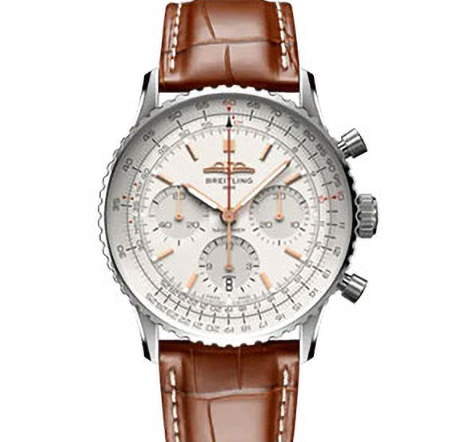
The Navitimer is born in 1952 at the direct request of the Aircraft Owners and Pilots Association (AOPA), the world's most important private pilots' association, which approached Breitling to develop a chronograph able to assist pilots with essential flight calculations: average speed, fuel consumption, climb and descent times, unit conversions. The technical solution is a circular logarithmic slide rule integrated into the rotating bezel, combined with a three-counter chronograph, mounted on a 41 mm case considered unusually large for the time but essential to ensure the scale's legibility. The first versions, produced for AOPA members, do not even carry the Breitling name on the dial; only from late 1955 is the watch marketed to the general public with the Breitling logo and winged emblem, retrospectively receiving the reference number 806.
In the 1960s the design evolved with the introduction of contrasting white sub-dials to improve legibility, while around 1965 the celebrated "twin jet" logo appeared, two stylized overlapping aircraft that have since become synonymous with the model. It is the decade of its consecration: the Navitimer is worn by figures such as trumpeter Miles Davis and several Formula 1 protagonists, turning from a purely onboard instrument into a cult watch even outside the aeronautical world. In 1969 Breitling takes part in the development of the Chrono-Matic, among the very first automatic chronograph movements in history, also applied to a larger-cased Navitimer version (ref. 1806, 47 mm).
In the following decades the line goes through the quartz crisis and the mechanical rebirth of the 1980s-1990s without ever leaving production, expanding with GMT, annual calendar and split-seconds chronograph variants. From 2018, under the direction of Georges Kern, the Navitimer is rationalized into a more coherent range with diameters from 38 to 43 mm and B01 manufacture movements, remaining the recognized progenitor of the entire Breitling pilot's watch family and one of the most imitated chronographs in the history of watchmaking.
Technical Specifications
Main Executions
The Navitimer's slide rule is not a simple decorative element: still today, by rotating the bezel, it allows calculations such as time-distance-speed or miles/kilometers and liters/gallons conversions, exactly as in 1952 — making it one of the very few wristwatches to keep a fully operational instrumental function seventy years after its introduction.