

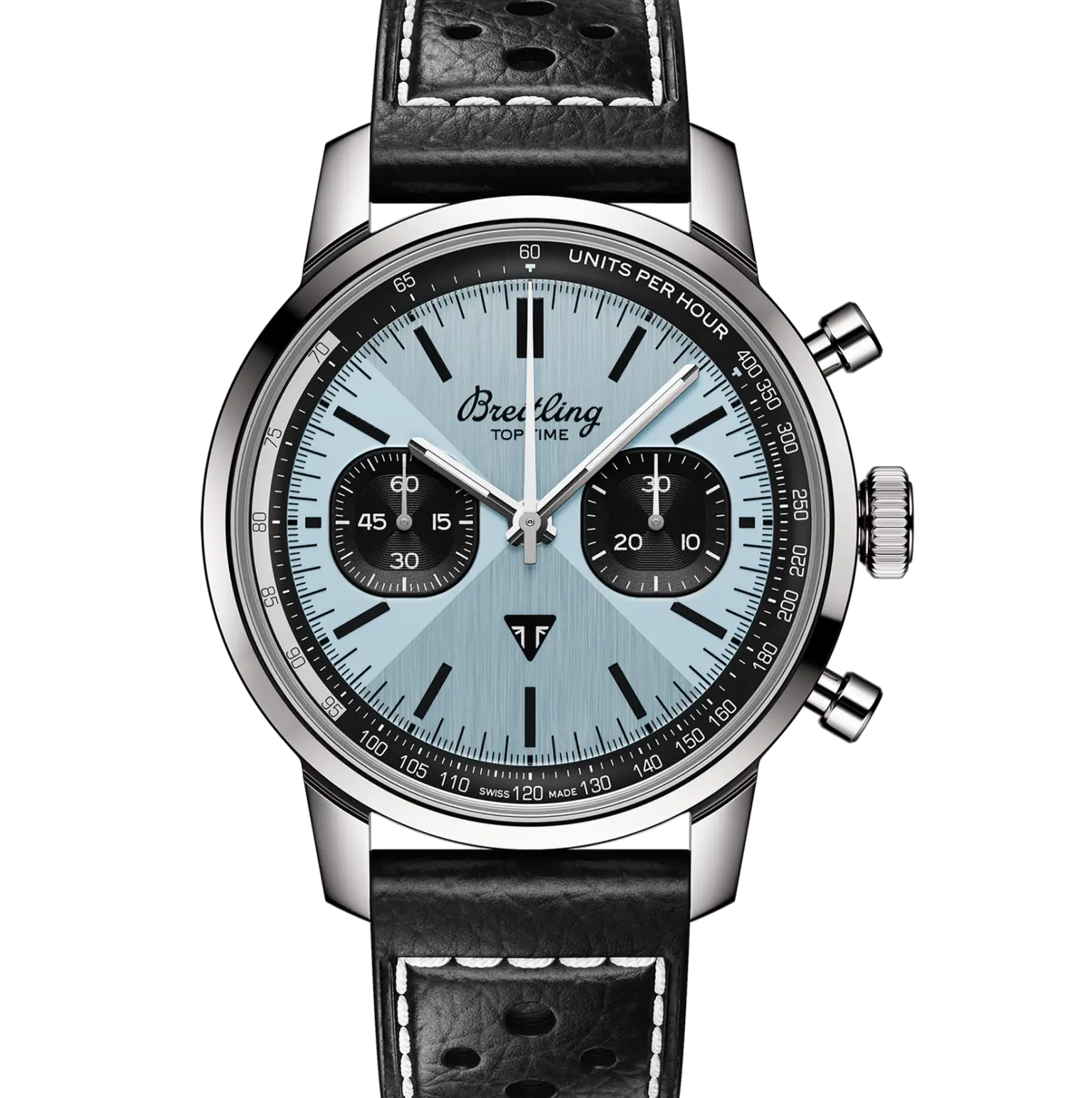
Model History
The Top Time is launched in 1964 by Willy Breitling with a declared goal: to speak to a younger audience than the mostly professional one of the brand's pilot or diving chronographs. "We are venturing into the field of youth, and we will speak their language," is said to have been the spirit behind the line's presentation: colorful dials, a more compact and accessible case, a price designed for an audience of newcomers to mechanical watchmaking looking for a sporty, fashionable instrument rather than a professional tool.
The Top Time's moment of greatest fame arrives the following year, in 1965, when a version of the model (ref. 2002) appears on James Bond's wrist in the film Thunderball, modified on screen with a Geiger counter integrated by Q's laboratories — one of the first cases of a "gadget" watch in the history of spy cinema. That specific piece, surviving to this day, was auctioned in 2013 for around 104,000 pounds, becoming one of the most expensive vintage Breitlings ever sold and consolidating the bond between the line and the cinematic imagery of the 1960s.
After decades of absence from the catalogue, the Top Time is reintroduced by Breitling in 2020 as a reissue faithful to the original spirit: two-tone dials, contrasting counters and compact 41 mm proportions, designed to bring back into current production the "young and informal" soul that had made the line famous in the 1960s, clearly distinguishing it from the more formal register of collections such as the Premier.
Technical Specifications
Main Executions
The Top Time worn by Sean Connery in Thunderball was not, originally, a simple prop watch: 007's "gadget" objects were chosen by Breitling precisely because they already had a credible technical aesthetic, able to make even a fictional device like the Geiger counter added by the film's prop makers look plausible.