

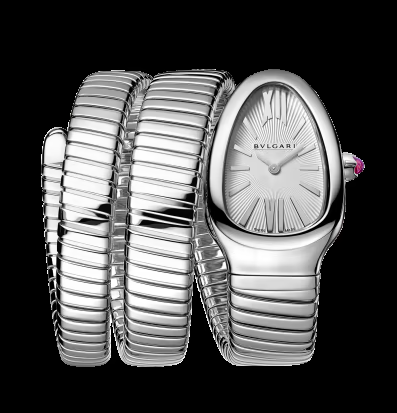
Serpenti
Model History
The serpent motif enters Bulgari's vocabulary in the 1940s, when the maison reinterprets in watchmaking form a symbol dear to Hellenistic and Roman jewelry: the first Serpenti are watch-bracelets with a flexible yellow gold body, head and tail embellished with diamonds, in which the dial is often hidden beneath the serpent's head, revealed only by lifting it. Not a simple watch, then, but a jewel with a timekeeping function, consistent with the maison's origin as a Roman high-jewelry atelier more than as a watchmaking manufacture in the strict sense.
The technical trait that makes the snake-skin effect possible is the Tubogas working method, a goldsmithing technique perfected in the second half of the nineteenth century and adopted by Bulgari starting from the late 1940s: thin gold strips are wound in a spiral around a removable core, with no soldering at all, obtaining a continuous, flexible bracelet that is surprisingly comfortable to wear, adapting to the wrist just as the skin of a real serpent would. In the 1960s and 1970s the collection is enriched with multi-coil executions, wrapping two or more times around the wrist or neck, winning over film divas such as Elizabeth Taylor, who in Rome for the filming of Cleopatra becomes one of the maison's most famous clients.
After a period of lesser centrality in the catalogue, the line is decisively relaunched starting in the 2010s as a true watch collection in its own right: on one side the Serpenti Tubogas, a watch with a curved case integrated into the spiral bracelet, closer in reading to a jewelry watch worn every day; on the other the more literal executions, with a gold and precious-stone serpent head that encloses and reveals the dial, designed as fine watch-jewelry pieces for the most formal occasions.
Technical Specifications
Main Executions
The bond between Bulgari and the world of cinema runs precisely through the Serpenti: during the Roman filming of Cleopatra in 1962, Elizabeth Taylor falls in love with the maison's serpent jewelry, going so far as to utter the famous line "the only word I know to describe Bulgari is wow" — an episode the company still cites today as part of its own mythology.