

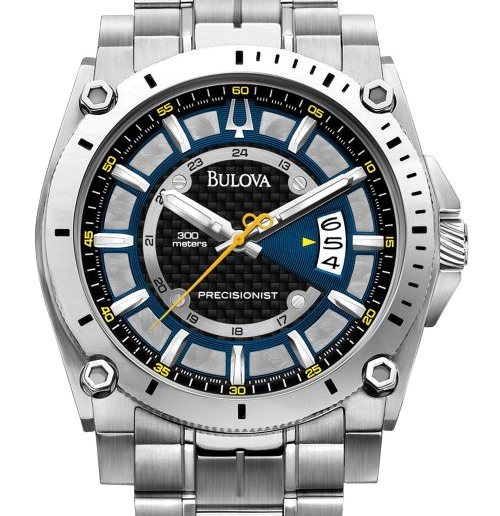
Model History
Presented in March 2010, the Precisionist was marketed by Bulova as the world's most accurate watch in its category. Its distinguishing feature was a UHF (Ultra High Frequency) quartz movement oscillating at 262,144 Hz, eight times the frequency of a traditional quartz movement (32,768 Hz).
This higher frequency eliminated the familiar one-second tick of the seconds hand, replacing it with a smooth, continuous sweep more commonly associated with mechanical movements — while retaining the accuracy and low maintenance of quartz technology.
The movement family was later commercially renamed "UHF262" and progressively applied across Bulova's wider catalogue, including sporty lines such as Marine Star, extending the technology well beyond the original Precisionist name.
Technical Specifications
Main Executions
At its 2010 launch, the promotional campaign claimed the title of "world's most accurate watch" — an echo picked up by the general tech press, and an almost identical claim, half a century later, to what Bulova had already declared for the Accutron back in 1960.