

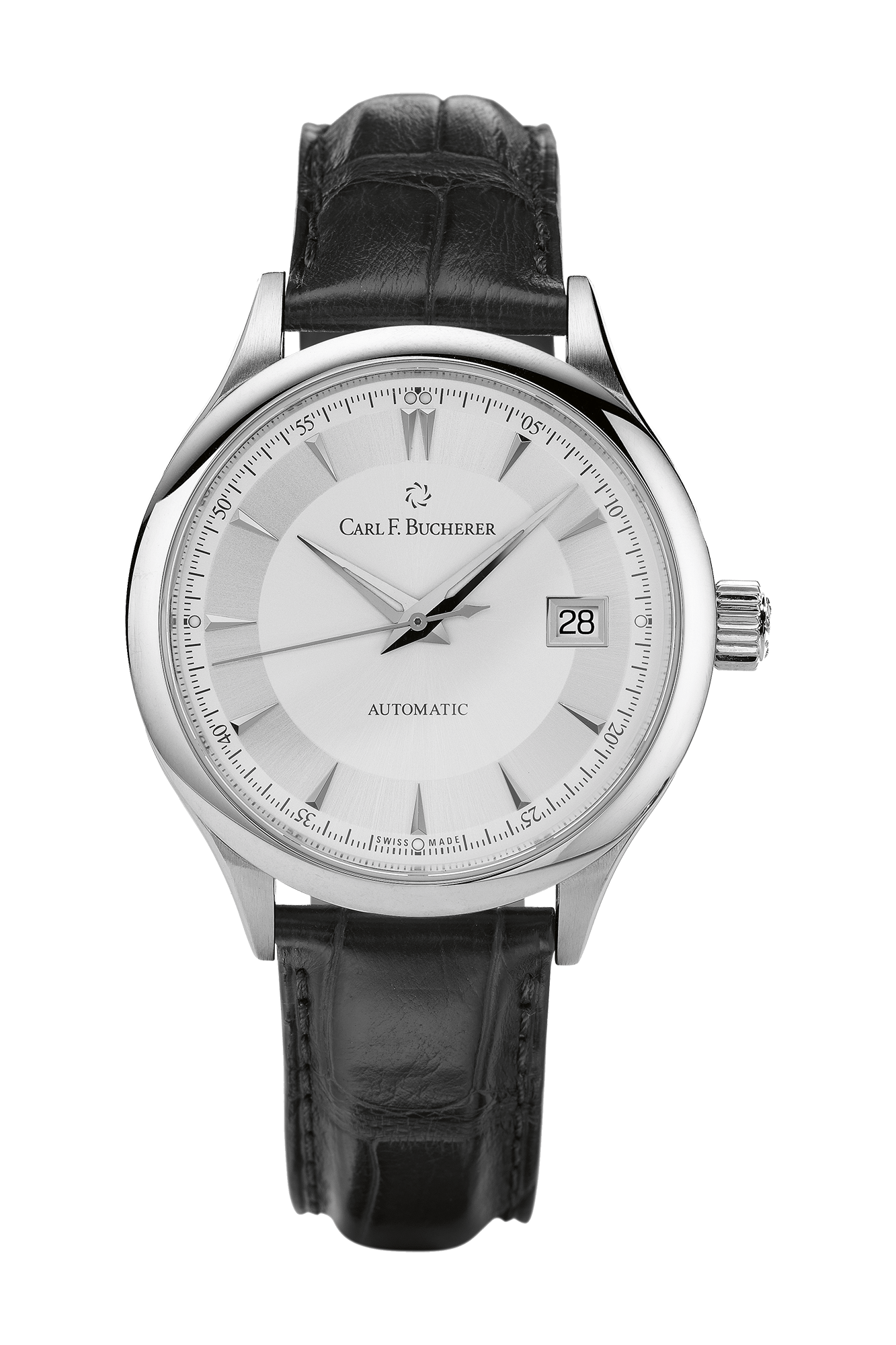
Manero
Model History
The Manero was born in the early 2000s, alongside the brand's relaunch as an independent manufacture, as a collection for a more classic and elegant audience compared to the catalogue's sportier proposals: round cases, sober dials and — over time — a growing number of complications, from the flyback chronograph to the tourbillon and the perpetual calendar. It is the line in which Carl F. Bucherer chose to more openly display its manufacturing know-how.
The turning point came in 2016 with the launch of the Manero Peripheral, the collection's first model fitted with the CFB A2000 calibre, an evolution of the peripheral rotor introduced in 2008 with the CFB A1000: through the sapphire crystal case back, one can observe the oscillating mass rotating around the movement's perimeter instead of at its center, leaving the central mechanics fully visible. In 2018 the range expanded with the 43.1 mm version and the COSC-certified CFB A2050 calibre, along with the Manero Tourbillon DoublePeripheral, which applies the same principle also to the tourbillon cage.
Over the years the Manero has also housed more traditional complications such as power reserve, flyback and big date, confirming itself as the catalogue's most heterogeneous line: a testing ground for technical experimentation wrapped in a deliberately sober aesthetic, designed not to compete in showiness with the sporty Patravi collections.
Technical Specifications
Main Executions
The Manero's peripheral rotor does not turn on a traditional central pivot, but runs along three small DLC-coated rollers mounted on ceramic ball bearings: a mechanical solution that reduces the movement's thickness while at the same time leaving an unobstructed view of the calibre's entire architecture through the case back.