

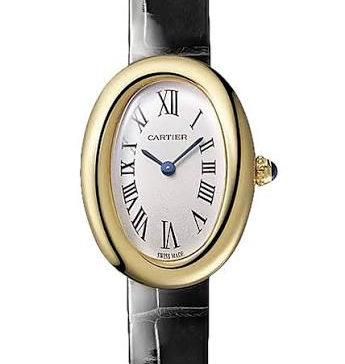
Baignoire
Model History
The Baignoire was born in 1912 as a bespoke creation, made by Louis Cartier for Grand Duchess Maria Pavlovna of Russia. The name by which it is known today, which in French means "bathtub", originates according to an anecdote passed down by the house itself: the grand duchess, seeing the oval, elongated case of her new watch, is said to have jokingly compared it to a Western-style bathtub. Another, less widespread theory instead links the name to the reserved boxes at the Paris Opéra Garnier, also called "baignoires". In any case, the name would only be officially adopted by Cartier in 1973, after decades in which the model circulated without a fixed designation.
Unlike the Tank or the Santos, the Baignoire remained for a long time an almost exclusive creation, made to commission for a limited clientele. It was only between the late 1950s and early 1960s that the model began to be produced with greater regularity and offered to a broader audience, while still keeping a low profile compared to other more celebrated collections of the brand — a discretion that, over time, became part of its identity.
The elongated oval case, lacking the squared side bands typical of the Tank, is designed to adapt to the wrist's natural curve rather than to assert itself as an object in its own right: an approach that in the 1960s found an even more radical extension in the Baignoire Allongée, a version with an even narrower and more elongated case. The dial, typically minimal, with Roman numerals and blued steel sword hands, remains consistent with the aesthetic language Cartier developed since the early twentieth century.
Technical Specifications
Main Executions
Despite being one of the oldest shapes ever created by Cartier — born the same year as the Tortue — the name "Baignoire" by which we know it today was officially adopted only in 1973, over sixty years after its creation: for most of its history, the model was simply "the oval watch" in the house's records.